Indecision: why your mind loops on a choice
Indecision is a thinking loop: your mind replays two options, and every what-if about one side gets a matching what-if about the other, so neither ever wins. It isn't laziness or weakness. It's care that has lost its stopping point, and it shows once you can see the rounds repeat.

You've listed the pros and cons. You've asked three friends. You've slept on it, twice. And you're still exactly where you started, except more tired.
Indecision gets described as being wishy-washy, or treated as a symptom of something that needs fixing. Neither fits what it feels like from the inside. From the inside, indecision is busy. Your mind is working hard. It's just working in a circle.
This guide looks at indecision as a thinking pattern: what keeps it going, how what-if thoughts hold both sides of a choice in balance, and how to tell the difference between weighing a decision and looping on one.
What indecision says about how you weigh choices
Most decisions get made without much thought. Indecision shows up around the ones that matter to you, where each option protects something you care about. Take the job and you might lose stability. Stay and you might lose the chance. Say something and you might hurt the friendship. Stay quiet and you might hurt yourself.
When both options carry a real cost, your mind tries to solve the uncertainty the way it solves most problems: by thinking it through. It replays each option, imagines how it would play out, checks the result, and goes back to the other one to compare. In the first few rounds, that's useful. You learn what each choice actually involves.
The trouble starts when the rounds stop producing anything new. The information is the same. The imagined outcomes are the same. But the mind keeps running them, because each pass leaves the same small doubt behind, and the doubt asks for one more pass.
Some people are more prone to this than others. Researchers who studied how people choose compared "maximizers," who look for the best possible option, with "satisficers," who look for one that's good enough. Maximizers reported more regret and less satisfaction with their lives (Schwartz and colleagues, 2002). If you recognize yourself in the first group, indecision isn't a flaw in your reasoning. It's a high standard running without a stopping point.
How what-if thoughts keep the loop going
What-if thoughts are the engine of indecision. Each option gets its own set:
- What if I take it and hate it?
- What if I don't, and this was the one chance?
- What if I regret leaving?
- What if I regret staying?
Notice the shape. Every what-if about one side has a matching what-if about the other. That symmetry is what keeps you stuck. As soon as one option starts to look better, a new what-if appears to balance it out. The loop isn't a lack of thinking. It's thinking that keeps both sides exactly level.
What-if thoughts are also hypothetical by nature. They're about outcomes that haven't happened and can't be checked from where you're standing. That's why more research, more advice and more time often don't help. They answer questions about facts, and the loop is running on questions about the future.
Once they're written down and followed up, many what-ifs don't happen. In one study, 29 students noted their worries for 10 days and then tracked them, and 91% didn't come true (LaFreniere and Newman, 2020). That says nothing about how your choice will turn out. It shows how a what-if can look once it meets a record.
The two sides of weighing a choice
In loopmind, weighing a decision is one of seven pattern families. It's the Decisional pattern, and like every pattern it has two sides: indecision and resolve.
Both come from the same place. The care that keeps you comparing options is the same care that, pointed differently, lets you commit to one and stand by it. Hesitating can protect you from a bad choice. It also takes something from you the longer it runs: time, sleep, attention, the chance to find out by actually trying.
Seeing indecision as one side of a pattern, rather than a personal failing, changes the question. Not "why can't I just decide?" but "which side of this am I on right now, and what pulls me toward the other?"
Weighing a decision, or looping on it
From the inside, deliberating and looping can feel identical. A few differences tend to give it away.
Weighing a decision, or looping on it?
- New information
- Weighing: When you're weighing a decision, each round adds something: a fact, a cost, a feeling you hadn't named.
- Looping: When you're looping, the rounds repeat.
- Concrete or abstract
- Weighing: Weighing sounds like "the commute would be forty minutes; I'd lose evenings with the kids."
- Looping: Looping sounds like "but what if it's the wrong choice?"
- What you're asking for
- Weighing: Weighing looks for information.
- Looping: Looping looks for certainty, which no option can give.
- Where it happens
- Weighing: Weighing often happens on paper, in a conversation, at a reasonable hour.
- Looping: Looping tends to happen at night, alone, without anything written down.
Research on repetitive thinking suggests the same habit tends to move when it's concrete and circle when it stays abstract (Watkins, 2008).
A related study looked at unfinished business. Students who wrote down how, when and where they'd do two pending tasks had fewer thoughts about those tasks intruding afterward than students who only described them (Masicampo and Baumeister, 2011). The tasks were errands, not life choices, but the pattern is familiar: a question with no next step keeps coming back.
None of these is a rule. They're signs that the thinking has stopped producing and started repeating.
When the decision is already made
Indecision doesn't always end when you choose. Sometimes it just changes tense.
You signed the lease, and you're still comparing it with the other two apartments. You accepted the offer, and every slow Monday reopens the question. You ended the relationship, and you keep replaying the version where you stayed. The choice is behind you, but the loop runs as if it were still open.
This is the same pattern pointed backward. The what-ifs are now about a road you didn't take ("what if the other one was better?"), and because that road can never be tested, the question can never be closed. It often borrows from going back over the past, which is its own pattern.
It helps to notice which kind you're in. Weighing an open decision is about gathering what you need to choose. Going back over a closed one rarely gathers anything new; it tends to ask the same question in a different light. Seeing that difference, in your own words, is a start.
Every pattern has two sides.
The mind that replays can also reflect. The one that worries can also plan. A pattern is how your mind moves, never the problem. loopmind shows you which side you've been closer to.
- Going back over what happenedRuminationReflection
- Running ahead to what might happenWorryPlanning
- Weighing a decisionIndecisionResolve
- Measuring yourselfSelf-criticismGrowth
- People, and what they meantInsecurityConnection
- The big questionsEmptinessMeaning
- What your body is telling youHealth worryBody awareness
Seeing your own indecision loops
Indecision is hard to see while you're inside it, because each round feels like the first. It becomes visible when you can look back across several rounds at once.
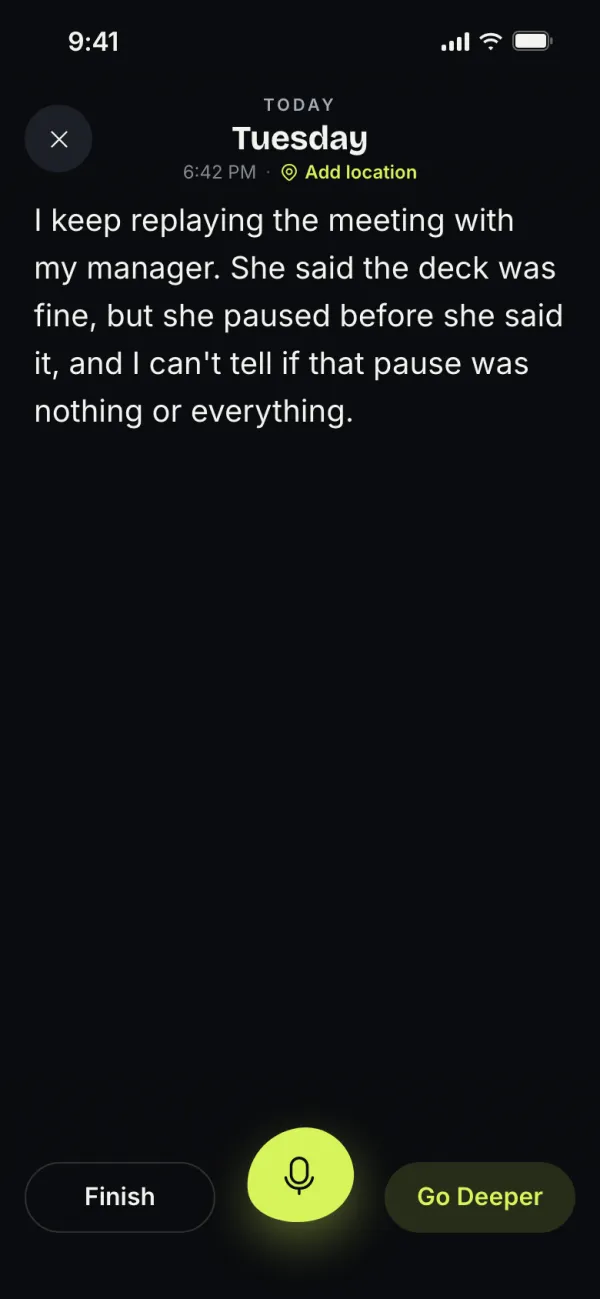
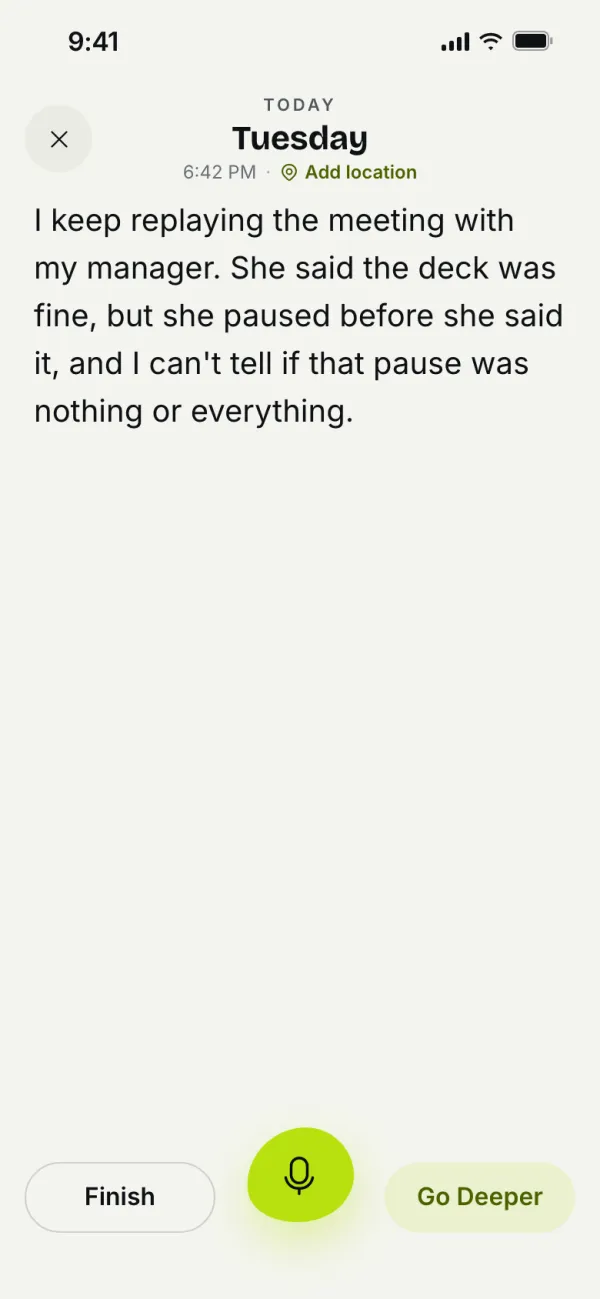 Check inSay it or type it, however it comes out. Messy is fine.
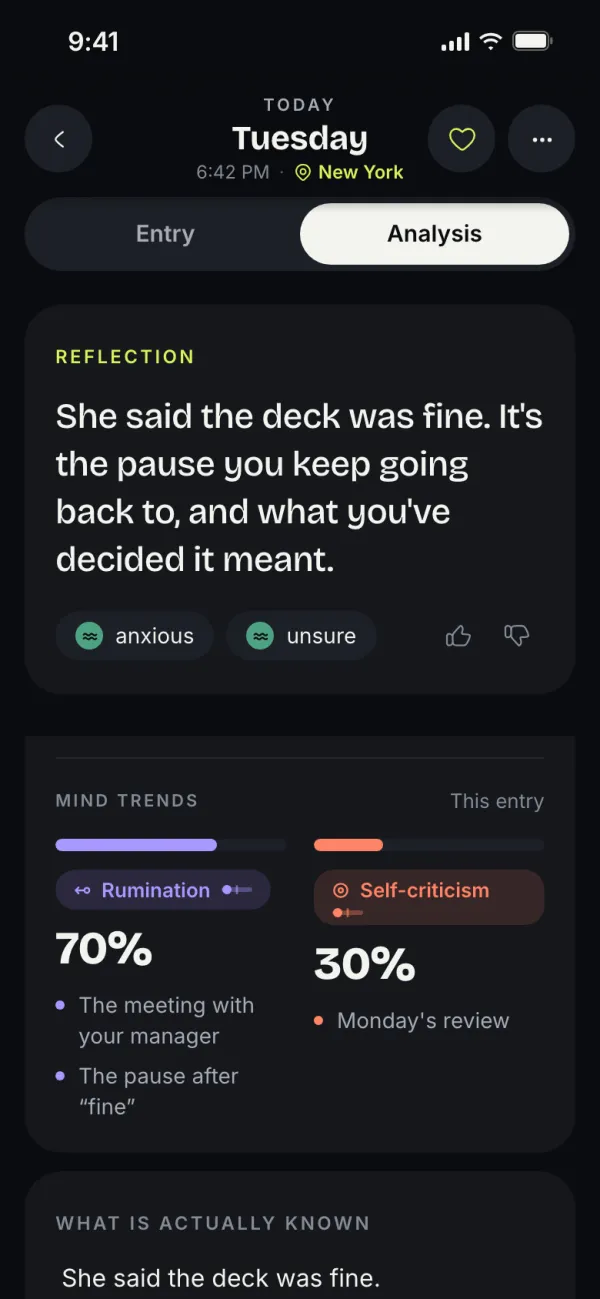
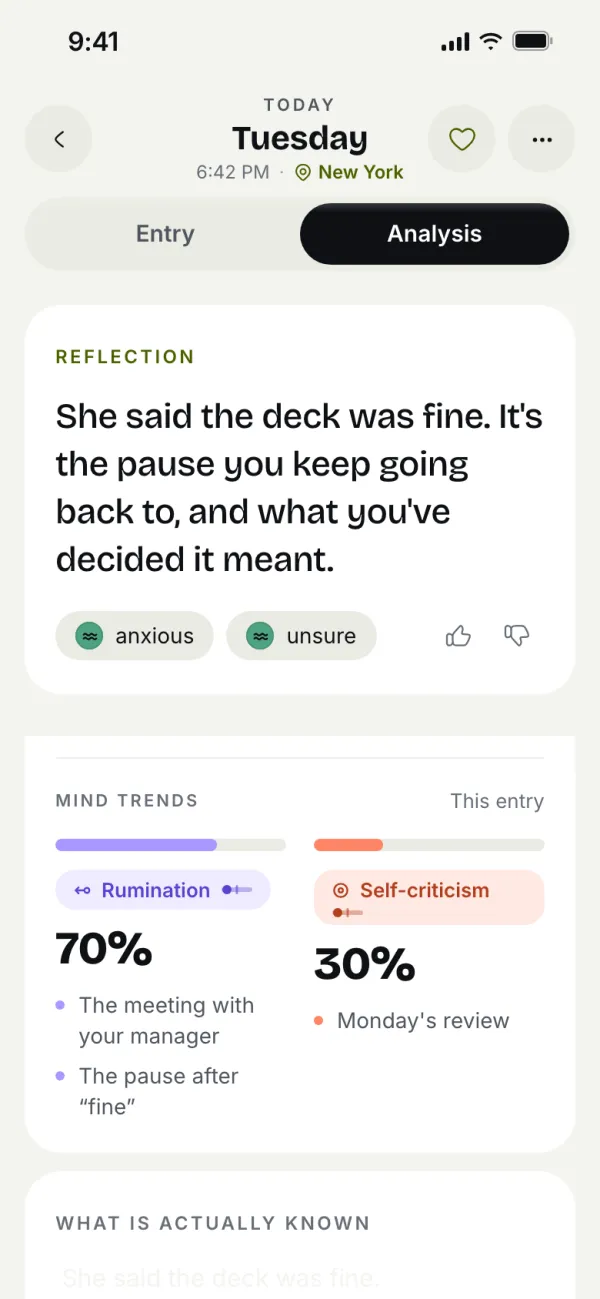 Your Reflectionloopmind reads your check-in and spots what's in it: the pattern showing up, and what your mind added to what happened.
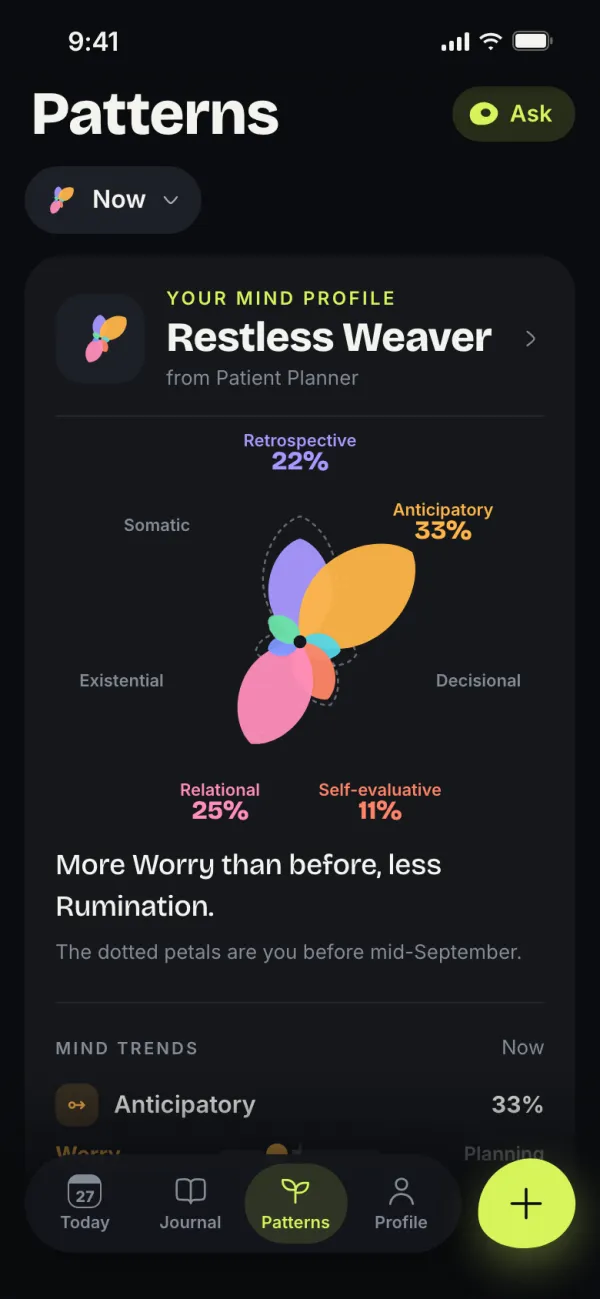
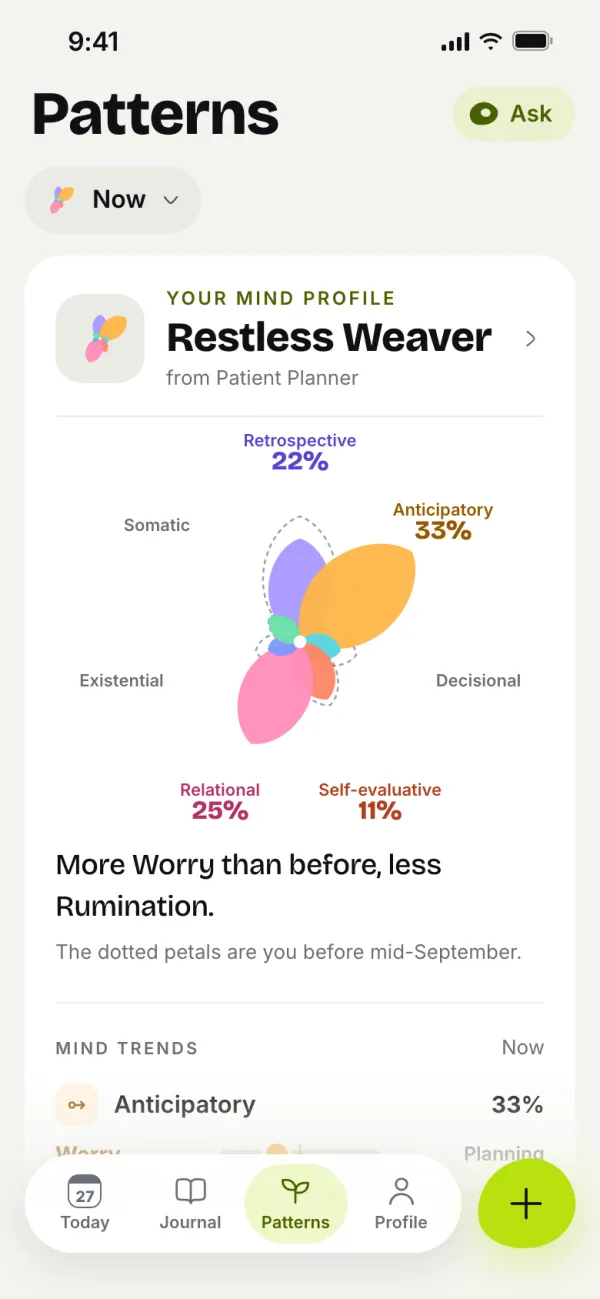 See how you thinkThe more you check in, the more of your mind you can see.
That's the idea behind loopmind. You check in, typed or out loud, whenever a decision is on your mind. After each check-in, you get one line back about your thinking: what's actually known, separated from what your mind is adding, and the patterns that showed up. Over days and weeks, you see how often the Decisional pattern comes up, which side you've been closer to, and what tends to come with it: the same person, the same kind of choice, the same time of night.
loopmind doesn't tell you what to decide. It doesn't diagnose, and it doesn't hand you a technique. It shows you how you've been thinking about the choice, in your own words, so you can see the pattern instead of running it again.
Still going back and forth on the job offer. If I take it I lose the team I like, if I don't I'll wonder forever. Asked Sam again tonight, same answer as last week.
Each round adds a what-if, not a fact: the options haven't changed since last week.
There's a job offer, and an answer is due.
Regret on both sides, before either choice is made.
- Decisional
- Anticipatory
Questions about indecision
Is indecision a sign of anxiety?
Not by itself. Everyone hesitates over choices that matter. If indecision comes with distress that affects your daily life, that's worth talking about with a professional. loopmind is a mirror for how you think, not a diagnosis or a substitute for care.
Why do what-if thoughts feel so convincing?
Because they're about the future, which can't be checked yet. A what-if can always be answered with another what-if, and the mind treats an open question as unfinished business.
Does making a pros and cons list help?
It can, the first time. A list is concrete, and it captures information. If you find yourself rewriting the same list, the list has become part of the loop.
Will seeing the pattern make the decision for me?
No. It shows you how you've been thinking about it. Many people find that seeing the loop written out, across several days, makes it easier to notice when they're weighing and when they're circling.
- Schwartz and colleagues, 2002. doi.org/10.1037/0022-3514.83.5.1178
- Watkins, 2008. doi.org/10.1037/0033-2909.134.2.163
- LaFreniere and Newman, 2020. doi.org/10.1016/j.beth.2019.07.003
- Masicampo and Baumeister, 2011. doi.org/10.1037/a0024192
Get it out.
See how you think.