Inner critic: why your mind keeps judging you
The inner critic is the part of your thinking that reviews what you do and finds you short: replaying a mistake, discounting a win, predicting you'll be found out. It isn't a diagnosis or a separate voice. It's a thinking loop about yourself, and arguing with it rarely settles it. Seeing it is a different way in.

You give the talk, people clap, and on the walk back to your desk a voice is already listing what went wrong: the slide you rushed, the joke that didn't land, the question you answered badly. Nobody else mentioned any of it. That voice is what people call the inner critic, and for many people it speaks more often than any other.
Most advice about the inner critic casts it as an enemy to defeat, or a voice to replace with a kinder one. This guide starts somewhere else: with how it works. The inner critic has habits. It picks certain moments, it uses certain words, and it sorts the evidence in a particular way. Once you know those habits, you can start to notice them in your own thinking, including in the version people call imposter syndrome.
What the inner critic is, and what it isn't
Everyone reviews their own work. Checking a report before you send it, going back over a conversation to see where it turned, noticing you were short with someone: that's the mind doing its job. The inner critic is what happens when the review stops being about the work and becomes about you. Not "that slide was rushed" but "I always do this." Not "I missed the deadline" but "I'm the kind of person who lets people down."
It also runs on repeat. A useful review happens once and ends in something: a fix, a note for next time, an apology. The inner critic goes back to the same moment, reaches the same verdict, and starts again, often hours or days later, often at night.
The inner critic isn't a diagnosis, and it isn't a separate voice living in your head. It's a habit of thinking about yourself, and it has a shape you can learn to see.
Why the inner critic sounds so convincing
Part of it is that the critic speaks in your own voice. It doesn't sound like an opinion; it sounds like you knowing yourself. And it usually starts from something true: the slide really was rushed. The critic takes that small true thing and builds on top of it.
Look at how it sorts the evidence. A mistake gets filed as proof of who you are: lasting, personal, about everything. A success gets filed as an exception: luck, timing, people being kind, a low bar. Over months, that filter builds a case that seems overwhelming, because only one kind of evidence was ever allowed to count.
The questions it asks matter too. Research on repetitive thinking suggests the same habit tends to circle when it stays abstract ("why am I like this?") and to move when it gets concrete ("what happened, and what would I change?") (Watkins, 2008). The inner critic lives at the abstract end. "Why do I always mess this up?" has no answer that would close it, so it can run for as long as you let it.
And it pulls feelings in. Response styles theory proposed that dwelling on how you feel and why tends to keep a low mood going longer than turning to something else (Nolen-Hoeksema, 1991). Going over a failure and what it says about you can feel like taking it seriously. By that account, it can also keep the feeling around.
Imposter syndrome: the feeling of being found out
Imposter syndrome is the inner critic at its most specific. You got the job, the promotion, the "you crushed it" in the team channel, and before the good news has sunk in, part of you is building the case for how you fooled them. You replay the interview looking for the moment they'll see through it. You picture the conversation you'll have when they do.
It often runs as a cycle. A new task arrives and the doubt spikes. You answer it by over-preparing, or by putting it off and then working in a rush. The task gets done, someone says it was good, and the praise gets dismissed: they were being nice, the project was easy, anyone could have done it. Then the next task arrives and the cycle starts again, with one more success logged as something you got away with.
That's why being told you earned it rarely lands. The loop isn't asking whether you earned it. It's checking whether you're about to be exposed, and reassurance becomes one more thing to check. It's also why the feeling often grows with success instead of fading: each step up is a bigger stage to be found out on.
Imposter syndrome isn't a diagnosis either. It's a name for a feeling many people describe, often people others would call successful. And it's a clear case of a self-criticism loop: the same audit, run after every win, reaching the same verdict whatever the evidence says.
The two sides of the inner critic
In loopmind, thinking about yourself is one of seven pattern families. It's the Self-evaluative pattern, and like every pattern it has two sides: self-criticism and growth.
Both start from the same place: caring how you do. Growth looks at a mistake and asks what it shows and what you'd change. Self-criticism looks at the same mistake and turns it into a verdict on who you are. The facts are identical. What differs is where the thinking goes after them.
Research on going over your own problems found a similar split. In a study of 1,328 adults, rumination divided into two parts: brooding, which was linked to lower mood a year later, and reflection, a more problem-solving turn inward (Treynor, Gonzalez and Nolen-Hoeksema, 2003). Turning toward yourself isn't the issue. The kind of turn is what differs.
From the inside, learning from a mistake and judging yourself for it can feel the same. A few differences tend to give it away.
Learning from a mistake, or judging yourself?
- Learning: Looks at one moment
- Judging: Turns one moment into who you are
- Learning: Asks what happened and what you'd change
- Judging: Asks why you're always like this
- Learning: Ends in a note for next time
- Judging: Ends in a verdict, then starts again
- Learning: Counts what went well too
- Judging: Files every success as luck
Negative self-talk: what it sounds like
Negative self-talk is the inner critic in words. Listen to it for a day and the same phrasing turns up. Absolutes: always, never, everyone, nothing. Labels in place of events: "I'm useless" rather than "I forgot the file." Predictions dressed as facts: "they're going to see through me." Comparisons with a version of everyone else who never struggles. Often it doesn't even say "I." It says "you," the way someone else might scold you.
The usual advice is to swap each sentence for a kinder one. Many people find that doesn't stick, and part of the reason is that the critic reviews the new sentence too: a kind line you don't believe becomes one more thing to argue with.
One study looked at a different move: not a kinder sentence, but a kinder view. Students who wrote to themselves for three minutes about a weakness, from an understanding point of view, saw that weakness as more changeable than students who wrote to boost their self-esteem or didn't write at all (Breines and Chen, 2012). Seeing a weakness as something that can change is close to the growth side of the pattern.
Pushing the words away has its own catch. In a classic study, people asked not to think about a white bear thought about it more afterward than people who had been free to think about it all along (Wegner, Schneider, Carter and White, 1987). Trying not to hear the critic keeps it close: to check that you aren't thinking a thought, the mind has to keep it in view.
Looking at the words is different from arguing with them or banning them. Once you can see that the critic says "always" about something that happened twice, or "everyone" about one person's reply, the sentence reads less like news about you and more like a habit of phrasing. The critic also rarely travels alone. It borrows from going back over what you said, and from rehearsing how the next time will go; the guide to overthinking looks at how those loops run together. When it fixes on a choice ("what if I pick wrong, again?"), it shades into indecision.
Seeing your own inner critic
The inner critic is hard to see from the inside, because each verdict feels like a fresh discovery. Its pattern shows when you can look back across many of them at once. Psychologists who study self-knowledge have found that people often don't know why they feel or act as they do, and that looking at your own behavior the way an outside observer would helps (Wilson and Dunn, 2004). A record of what you actually said, on ordinary days, is one way to get that outside view.
That's what loopmind is built around.
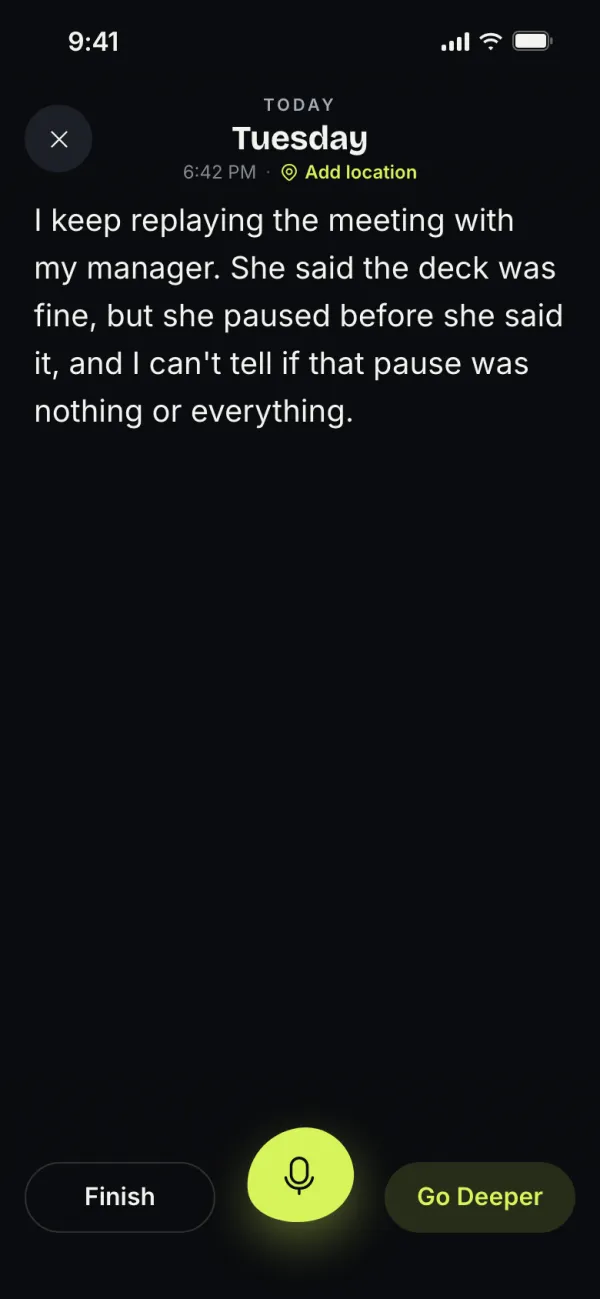
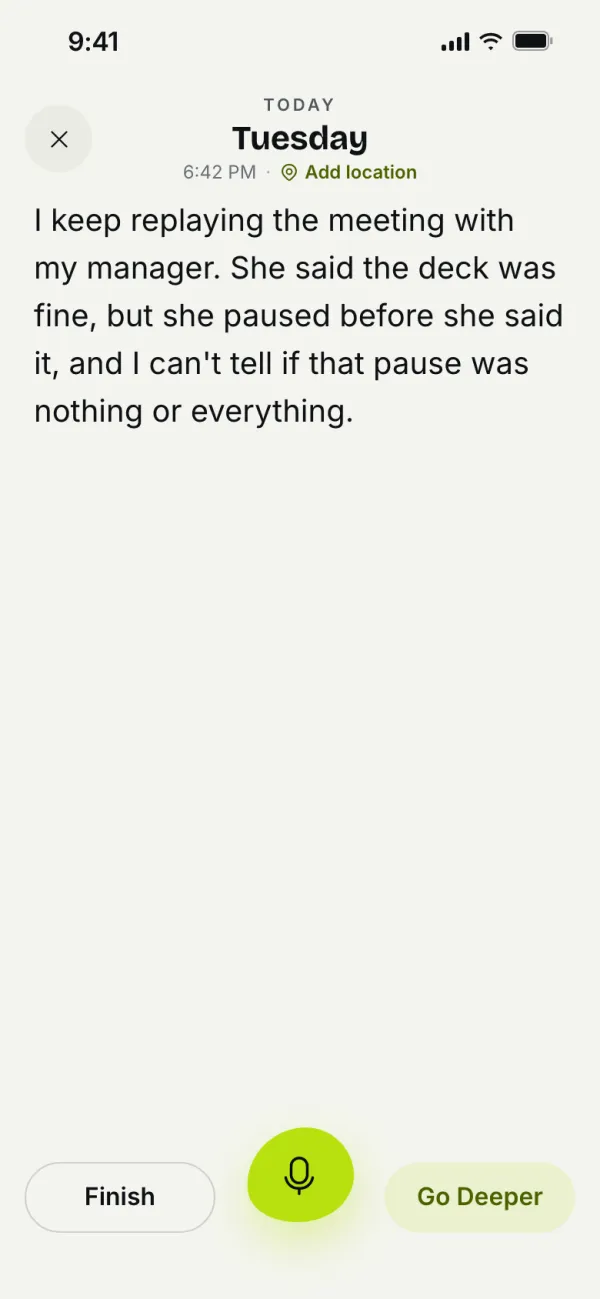 Check inSay it or type it, however it comes out. Messy is fine.
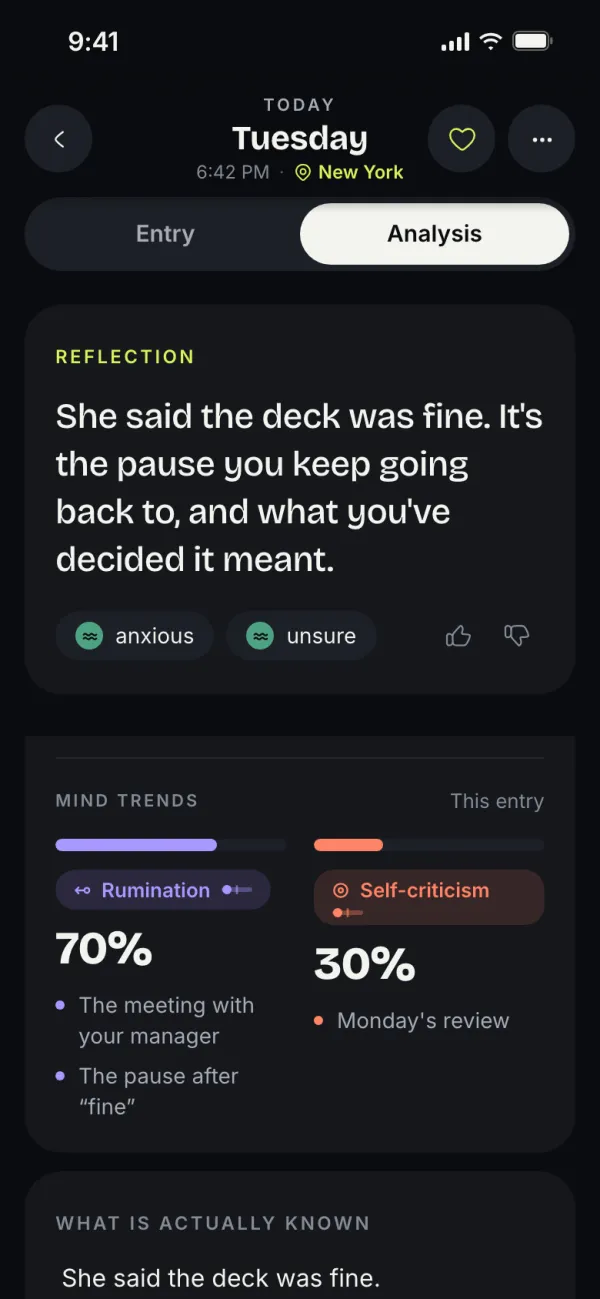
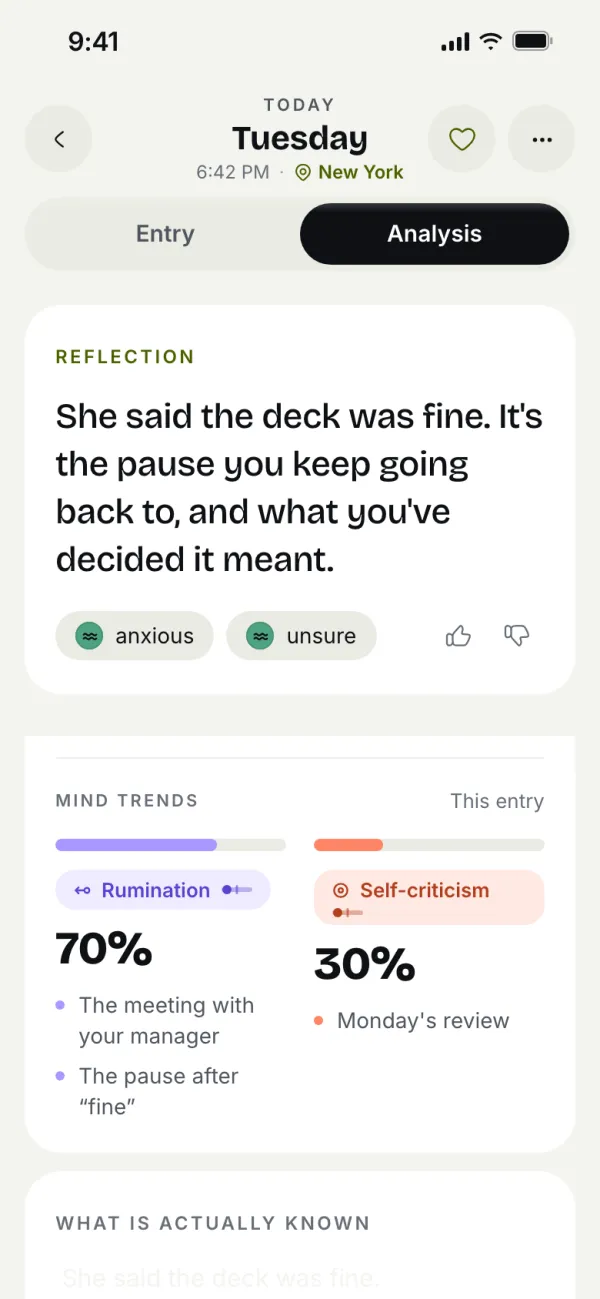 Your Reflectionloopmind reads your check-in and spots what's in it: the pattern showing up, and what your mind added to what happened.
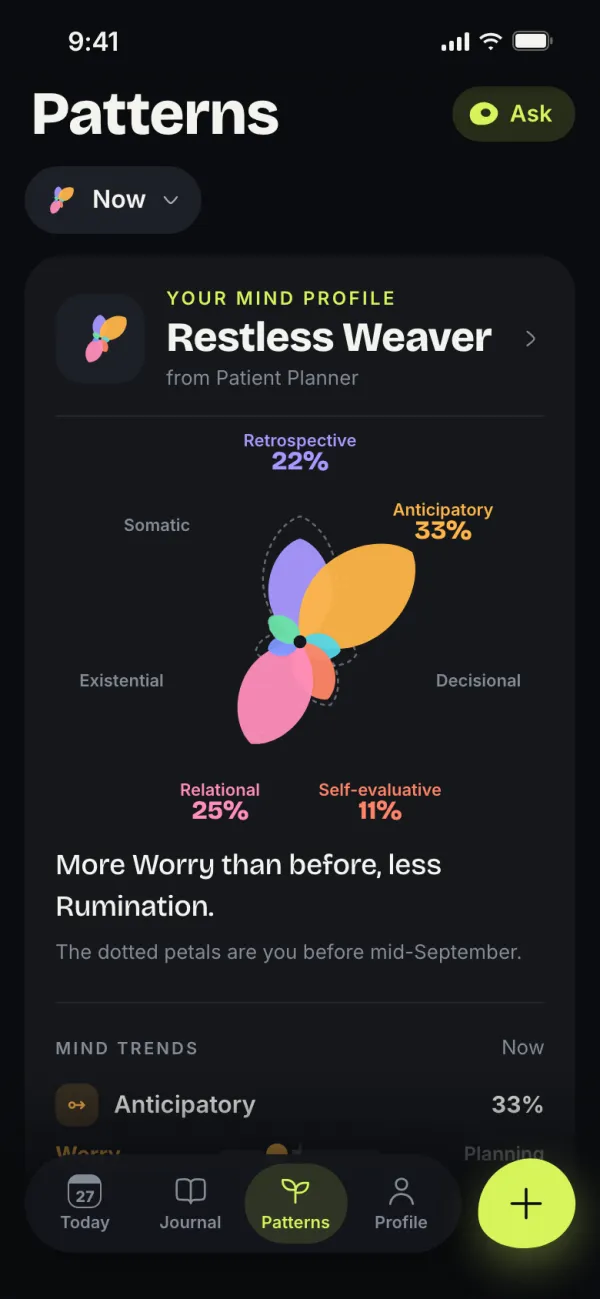
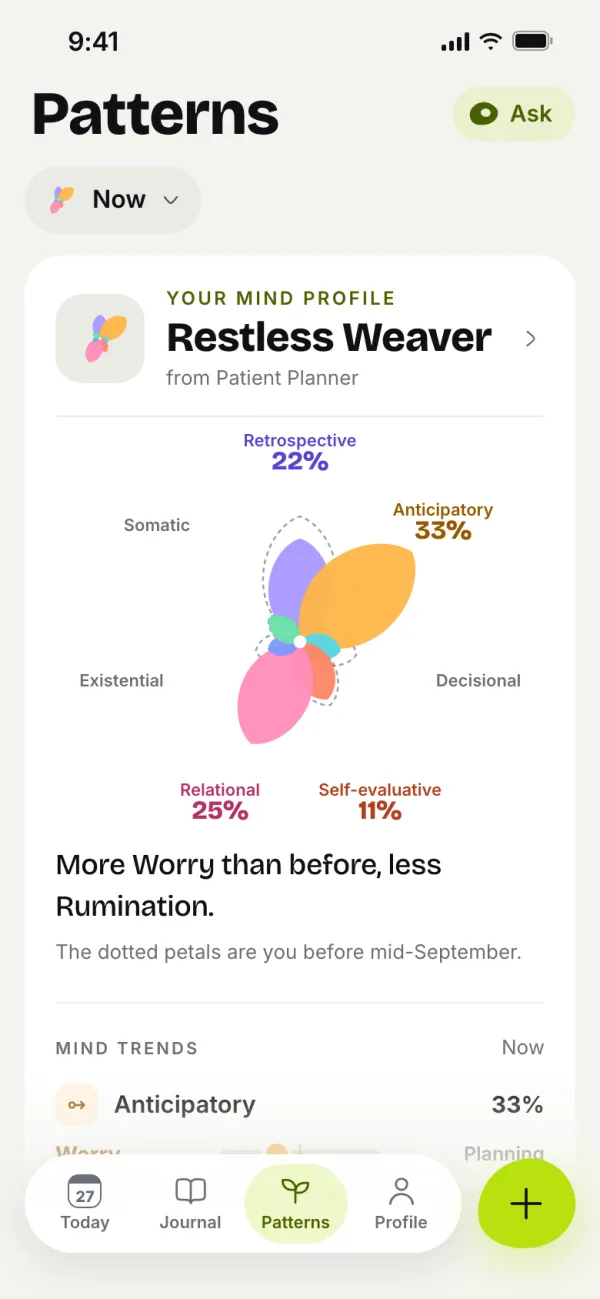 See how you thinkThe more you check in, the more of your mind you can see.
You check in, typed or said out loud, whenever something's on your mind: a meeting that went wrong, praise you can't take in, a mistake on repeat. loopmind reads it back with one line about your thinking: what's actually known, set apart from what your mind added, and the patterns that showed up. Here's what that looks like for a made-up check-in.
Marc said my report was the clearest one this quarter. The whole drive home I kept thinking he only said it because the others were late, and that next quarter he'll see what I missed.
One compliment came in; the rest of the drive went to a mistake nobody has found.
Marc said the report was the clearest this quarter.
That he was being kind, and that next quarter he'll see what you missed.
- Self-evaluative
- Anticipatory
Inès got one compliment. Everything else in her check-in, the kindness she suspects behind it and the mistake she expects next quarter, is what her mind added on the drive home. Seeing the two side by side is what the line is for. It doesn't tell her she's good at her job, and it doesn't hand her a technique. It shows her where the thinking went.
Over days and weeks, the check-ins add up. You see how often the Self-evaluative pattern comes up, which side of it you've been closer to, and what tends to come with it: the same manager, the same kind of task, the same hour of the evening. That's a large part of getting to know how you think. loopmind Clarity adds the longer view, including how your mind is shifting from month to month.
What changes when you can see your inner critic
Seeing the critic over time doesn't come with a promise that it goes quiet. What it gives you is information. You might find it's loudest the evening after a meeting with one particular person. You might notice that praise sets it off more than mistakes do. You might see that it gathers around one part of your life, work or family or how you look, and barely shows up anywhere else.
That kind of detail is hard to reach by thinking about yourself in general, which is the critic's favorite ground. It comes from your own words, gathered on ordinary days. It's also why loopmind leaves out diagnosis and advice: it's a mirror, not a therapist. If you're working with one, a record like this can be something to bring to a session. It's a help between sessions, never a replacement. If you need someone to talk to now, the support page lists real helplines.
The research behind loopmind lists the studies the patterns draw on.
Questions about the inner critic
Where does the inner critic come from?
There's no single answer. Many people recognize in it an old standard: a parent, a teacher, a workplace where mistakes were costly. What's easier to see than where it came from is how it runs now: when it speaks, about what, and what it adds to what actually happened.
How do I silence my inner critic?
Trying to silence it tends to backfire: in a well-known study, people asked not to think of a white bear thought of it more afterward. Thoughts don't switch off on command. What can change is how well you know the critic: what sets it off, what it says, and how much of it describes what happened rather than adding to it.
Is imposter syndrome a mental health condition?
No. Imposter syndrome isn't a diagnosis. It's a name for the feeling of being a fraud despite evidence of doing well, and many people describe it. If it comes with distress that gets in the way of your days, that's worth talking about with a professional. loopmind is a mirror for how you think, not a substitute for care.
Is self-criticism ever useful?
Looking honestly at what you did is useful: it's how people learn. In loopmind, that's the growth side of the Self-evaluative pattern. It turns into self-criticism when one moment becomes a verdict on who you are, and the same verdict keeps coming back.
Is negative self-talk the same as the inner critic?
Close. The inner critic is the habit of judging yourself; negative self-talk is the words it uses: always, never, "I'm useless", "they'll find out". Paying attention to the words is often the easiest way to notice the habit.
- Watkins, 2008. doi.org/10.1037/0033-2909.134.2.163
- Nolen-Hoeksema, 1991. doi.org/10.1037/0021-843X.100.4.569
- Treynor, Gonzalez and Nolen-Hoeksema, 2003. doi.org/10.1023/A:1023910315561
- Wegner, Schneider, Carter and White, 1987. doi.org/10.1037/0022-3514.53.1.5
- Wilson and Dunn, 2004. doi.org/10.1146/annurev.psych.55.090902.141954
- Breines and Chen, 2012. doi.org/10.1177/0146167212445599
Get it out.
See how you think.