Self-discovery in practice: how to see the way you think
Self-discovery is noticing how your mind actually runs: what you keep thinking about, what sets it off, and what you add to what happened. A quiz gives you a category for one moment. Getting to know yourself happens across real days, and it shows in the patterns your own words leave behind.

Most advice about self-discovery points you somewhere else. Take a personality test. Answer fifty questions about yourself. Go on a retreat. Wait for the moment it all clicks.
Those can be interesting. But they share one problem: they ask you to describe yourself from the outside, in general terms, at one moment. How you actually think shows up somewhere else. It shows up on a Tuesday night when a message goes unanswered, on the drive home after a meeting, at 2 a.m. when a decision you made last week comes back for another round.
This guide is about that second kind of self-discovery: getting to know yourself by watching what your mind does, repeatedly, in real life.
What self-discovery means day to day
Self-discovery is often framed as finding out who you "really" are, as if there were one hidden answer waiting to be uncovered. In practice, the more useful questions are smaller:
A label, or a pattern?
- A personality test: One moment, answered in ten minutes
- Your own check-ins: Real days, over weeks
- A personality test: Averages you out
- Your own check-ins: Keeps the conditions: this person, this time of day
- A personality test: Gives you a category
- Your own check-ins: Shows what you keep thinking
- A personality test: Stays the same
- Your own check-ins: Moves when you do
- What do I keep thinking about?
- What sets it off?
- Where does my mind go next, and how long does it stay there?
- What do I add to what actually happened?
None of these has a one-time answer. They change with the season, the job, the relationship. That's why a single snapshot, however detailed, tends to feel right for a week and then stop telling you anything new.
There's also a well-documented limit to looking inward. Psychologists who study self-knowledge have found that people are often unsure why they feel or act the way they do, and fill the gap with a plausible story (Wilson and Dunn, 2004). One of the ways they suggest getting past it is to look at your own behavior more like an outside observer would: what you actually did, said and returned to, rather than what you believe about yourself.
Why personality tests only go so far
A personality type gives you a category. Categories are useful for conversation ("I'm an introvert," "I'm a planner"), but they flatten the part that matters most for getting to know yourself: the conditions.
You might plan carefully at work and freeze over personal decisions. You might be generous with friends and harsh with yourself. You might be calm on most days and stuck in the same loop every time one particular person goes quiet. A test answered in ten minutes can't see any of that, because it asks you to average yourself out.
The details live in the specifics: this situation, this thought, this person, this time of day. That's where self-discovery gets practical.
The trap: trying to think your way to clarity
If you tend to overthink, you've probably tried to figure yourself out by thinking harder. You lie awake turning the same questions over. Why did I react like that? What's wrong with me? Why do I always do this?
Researchers who study repetitive thinking describe exactly this. The same habit of returning to a problem can go two ways. When it stays abstract ("why am I like this?"), it tends to circle. When it gets concrete ("what happened, what did I do, what's next?"), it's more likely to move (Watkins, 2008).
So the question isn't whether to think about yourself. It's how. Circling inside your head keeps everything abstract. Getting the thought out of your head, into words, where you can look at it, is what makes it concrete.
Getting to know yourself by spotting your patterns
Look back over a few weeks of what you think about and you'll notice it isn't random. The same kinds of thoughts come back. loopmind groups these patterns into seven families:
Every pattern has two sides.
The mind that replays can also reflect. The one that worries can also plan. A pattern is how your mind moves, never the problem. loopmind shows you which side you've been closer to.
- Going back over what happenedRuminationReflection
- Running ahead to what might happenWorryPlanning
- Weighing a decisionIndecisionResolve
- Measuring yourselfSelf-criticismGrowth
- People, and what they meantInsecurityConnection
- The big questionsEmptinessMeaning
- What your body is telling youHealth worryBody awareness
A pattern isn't a problem in itself. Each one has two sides. Going back over the past can be rumination, or it can be reflection. Thinking ahead can be worry, or it can be planning. Weighing a choice can turn into indecision, or it can end in resolve. Judging yourself can be self-criticism, or growth.
This idea has roots in research. In a study of 1,328 adults, rumination split into two parts: brooding, linked to lower mood a year later, and reflection, a more problem-solving way of turning inward (Treynor, Gonzalez and Nolen-Hoeksema, 2003). The same tendency, pointed differently.
That's where getting to know yourself gets specific. Not "I'm an overthinker," but "when work goes quiet, I go back over what I said, and it's mostly rumination, not reflection." That's a sentence you can do something with.
Using regular check-ins as a mirror
You can't see a pattern in one moment. You need a record. The simplest record is a short check-in: a minute, typed or said out loud, about what's on your mind.
Putting what's going on into words is one of the oldest ways people make sense of it. A review of 146 studies of expressive writing found a small but real effect (Frattaroli, 2006). The bigger value for self-discovery is what builds up over time: dozens of check-ins you can look back across.
This is what loopmind is for:
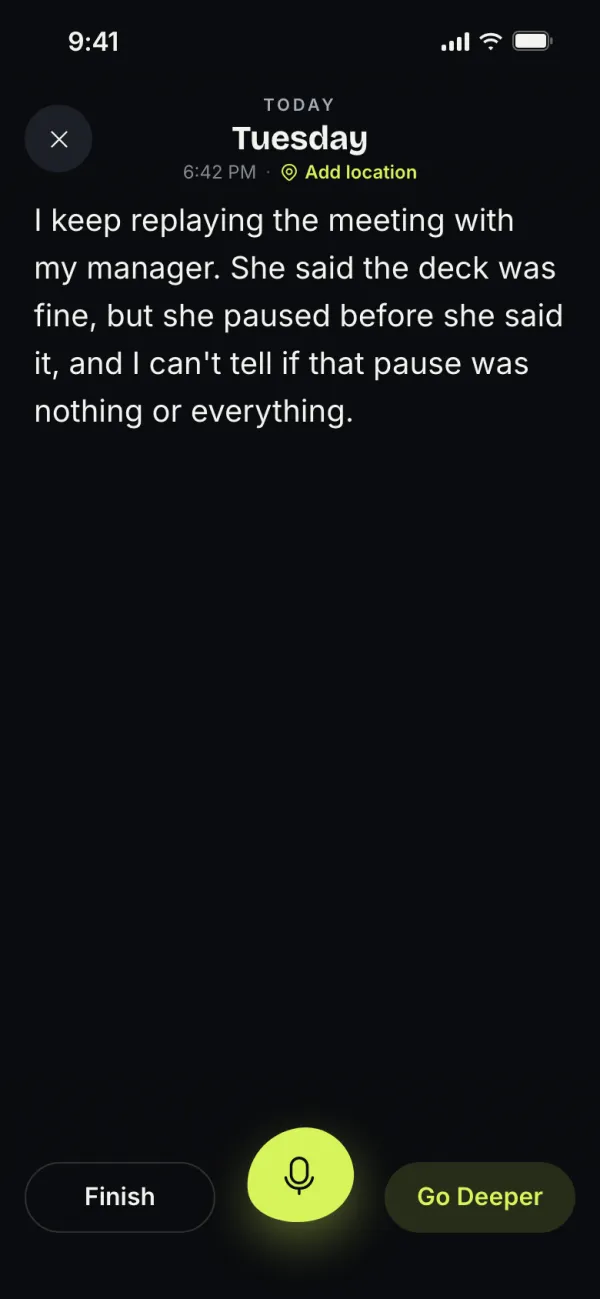
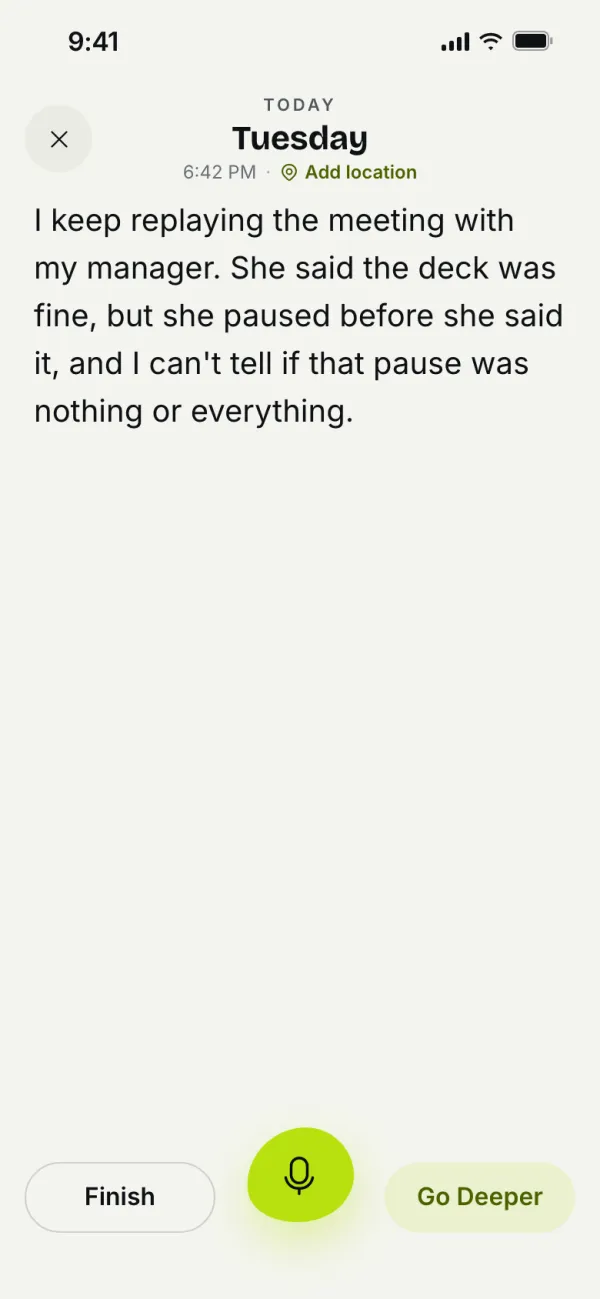 Check inSay it or type it, however it comes out. Messy is fine.
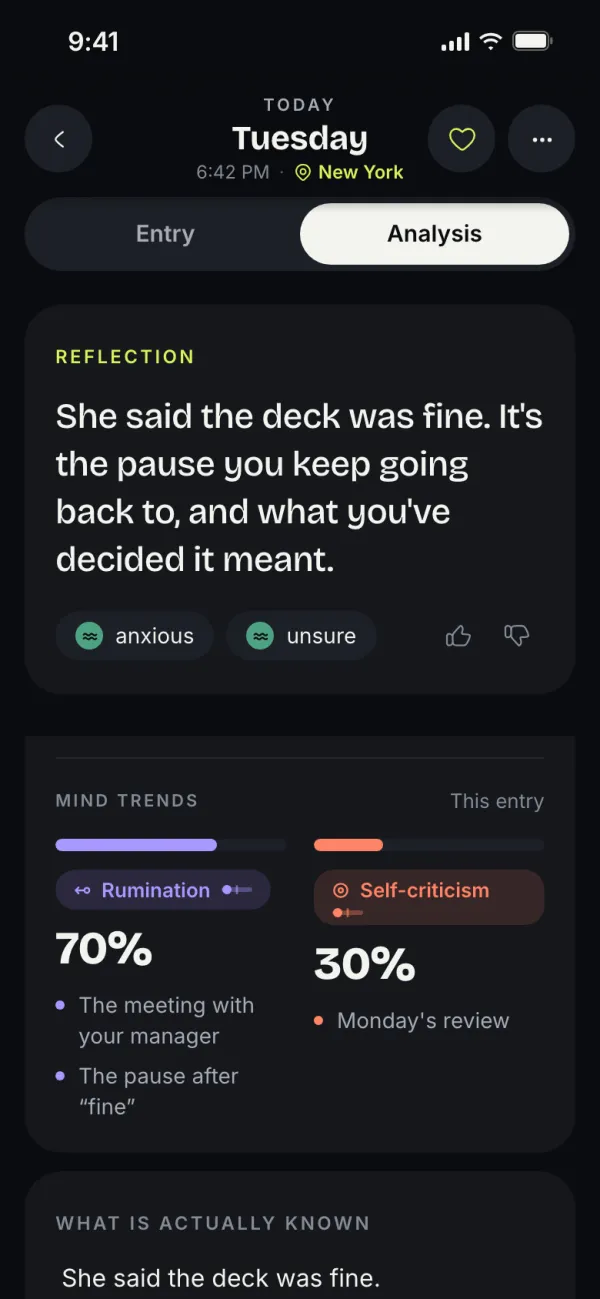
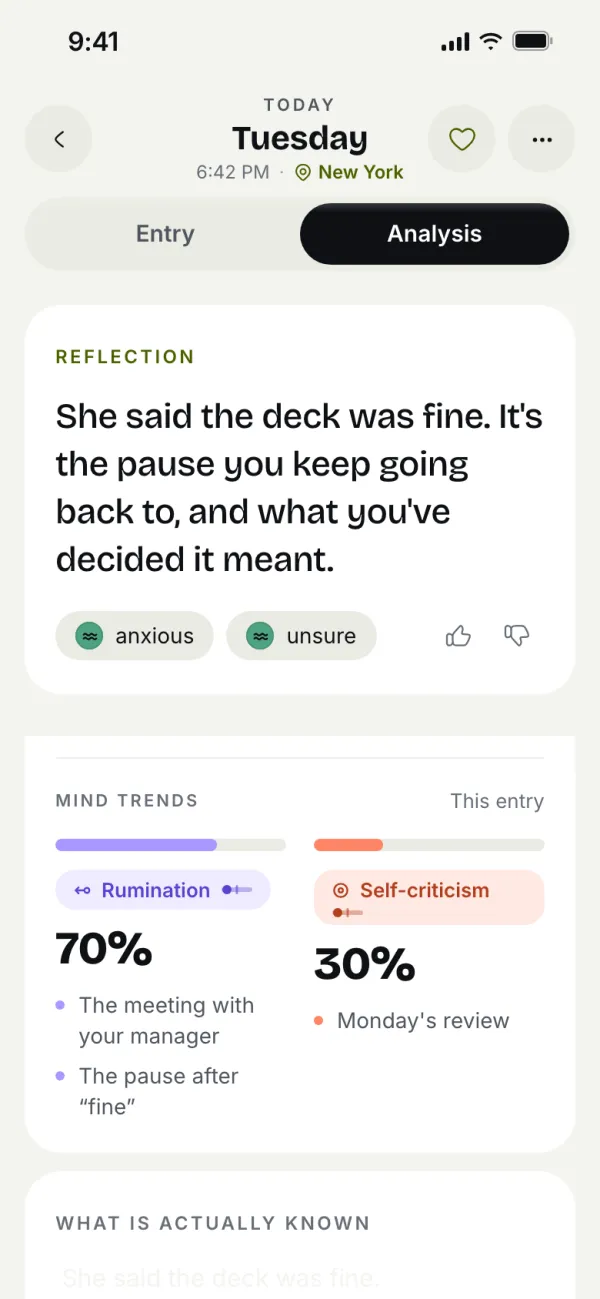 Your Reflectionloopmind reads your check-in and spots what's in it: the pattern showing up, and what your mind added to what happened.
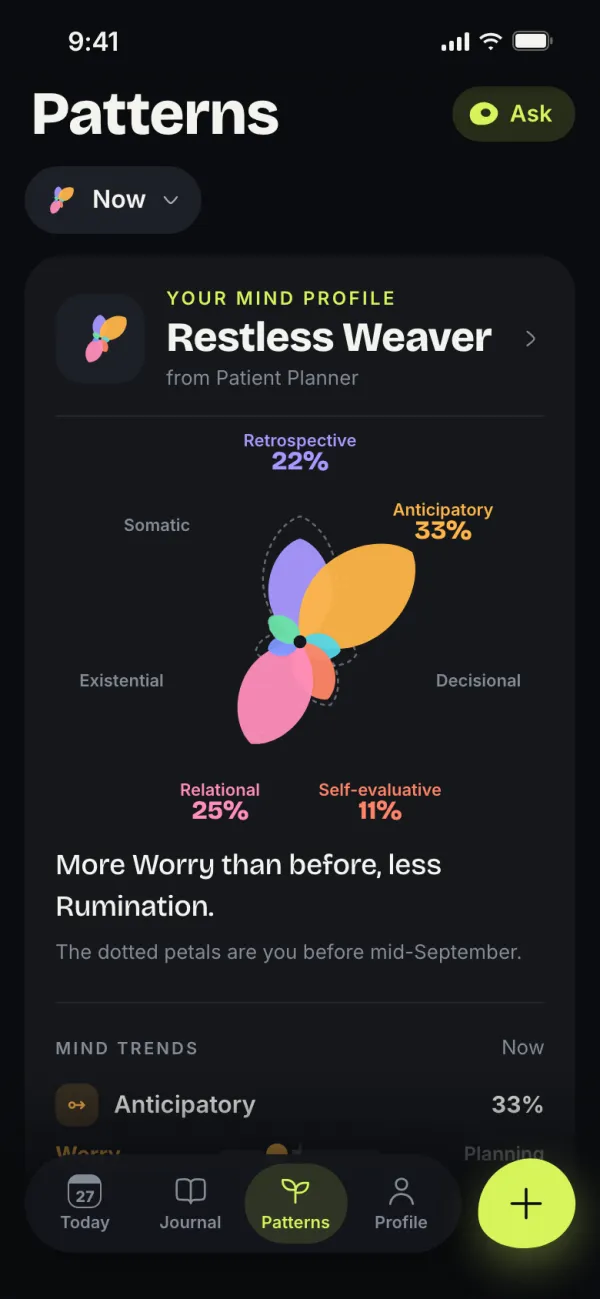
 See how you thinkThe more you check in, the more of your mind you can see.
Julie didn't answer my message about the weekend. Third time this month I've spent the evening going over what I wrote.
The message is sent; the evening went to rereading it, as the last two times did.
A message about the weekend hasn't had a reply yet.
That the wording was wrong, and what Julie must think.
- Relational
- Retrospective
loopmind works like a mirror, not a therapist. It doesn't diagnose you, tell you what you have, or give advice you didn't ask for. It shows you what you've been thinking, in your own words, so you can see the shape of it. loopmind Clarity adds the longer view: how your mind is shifting, your month read back to you, and Ask loopmind, where you can ask about yourself and get answers from your own entries.
Knowing yourself across good days and hard ones
One of the quieter benefits of a running record is perspective. On a hard day, it can feel like you've always felt this way. Looking back across a month shows you that you haven't. You'll see the weeks a loop barely came up, and the weeks it ran every night.
You'll also start to notice what tends to come with each state of mind. The same person in three different stressful check-ins. The same Sunday evening. The same kind of decision. That isn't a diagnosis. It's information about how your mind works, gathered from your own life rather than a questionnaire.
If you're working with a therapist, a record like this can be useful between sessions, to bring in what you noticed. It isn't a replacement for care. If things get heavy, the support page lists real helplines.
Questions
How often should I check in?
Whenever something is on your mind. Some people check in daily, others only when a thought won't let go. Patterns start to show after a handful of check-ins and get clearer over weeks.
What if I keep checking in about the same thing?
That's the point. Repetition is the pattern. Seeing the same thought come back, and noticing when it comes back, is often the first real piece of self-knowledge.
Isn't this just journaling?
It's related, but the goal is different. A journal keeps what you wrote. Checking in is about seeing what you keep thinking, across all of it, so the pattern becomes visible without rereading every page.
Do I need to be an overthinker for this to help?
No. Many people come to loopmind because they overthink, but the same practice works for anyone curious about how their mind runs: what sets it off, where it goes, and what it adds.
- Wilson and Dunn, 2004. doi.org/10.1146/annurev.psych.55.090902.141954
- Watkins, 2008. doi.org/10.1037/0033-2909.134.2.163
- Treynor, Gonzalez and Nolen-Hoeksema, 2003. doi.org/10.1023/A:1023910315561
- Frattaroli, 2006. doi.org/10.1037/0033-2909.132.6.823
Get it out.
See how you think.