Overthinking: why your mind loops, and how to see it
Overthinking is thinking that keeps circling a question it can't settle: replaying what happened, rehearsing what might, weighing a choice that won't close. It isn't a flaw or a diagnosis. It's a pattern you can learn to see. Pushing the thoughts away tends to bring them back; looking at the loop is a different way in.

You send the email, close the laptop, and an hour later you're still drafting a better reply in your head. You agree to a plan on Friday and spend Saturday wondering whether you should have said no. That's overthinking: the mind staying on something long after staying there stopped being useful.
Most pages about overthinking open with a list of ways to make it go away. This one starts with how it works. Overthinking has a shape. It runs on certain kinds of questions, it gets louder at certain times, and it tends to repeat the same few patterns. Once you know the shape, you can start to notice it in your own thinking.
What overthinking is, and what it isn't
Thinking a lot isn't the same as overthinking. Planning a trip, working through a hard problem at work, going over a conversation to understand it: that's the mind doing its job. The difference is in what each round produces. Useful thinking moves. Each pass adds a fact, a step or a decision.
Overthinking goes back to the same place, asks the same question, and comes out with nothing new except a little more doubt. It tends to gather around three kinds of questions: about the past ("why did I say that?"), about the future ("what if it goes wrong?") and about choices ("what if I pick the wrong one?").
What those questions share is that thinking alone can't close them. The past can't be rerun, the future can't be checked yet, and no option comes with a guarantee. So the mind keeps working on a problem it was never going to solve from the inside.
Overthinking isn't a diagnosis, and it isn't a character flaw. It's a habit of attention, and like most habits it runs best when nobody is looking at it.
Why your mind keeps going back
Part of the answer is that an open question feels like unfinished business. Minds hold on to what isn't done, and a doubt reads as exactly that. Each round of thinking leaves a small piece of uncertainty behind, and that piece asks for one more round.
Another part is the kind of thinking involved. Research on repetitive thought suggests the same habit can help or harm depending on how it runs. When it stays abstract ("why does this always happen to me?"), it tends to circle. When it gets concrete ("what happened, and what's the next step?"), it's more likely to move (Watkins, 2008). Overthinking usually lives at the abstract end, which is how it can run for hours without arriving anywhere.
Feelings get pulled in too. Response styles theory, an influential account from the early 1990s, proposed that dwelling on how you feel and why tends to keep a low mood going longer than turning to something else (Nolen-Hoeksema, 1991). Going over a feeling again and again isn't always the same as working through it.
The two sides of overthinking
In loopmind, the patterns people's thinking runs in fall into seven families. Overthinking can show up in any of them, but the one it's most often about is the Anticipatory pattern: running ahead to what might happen.
Every pattern has two sides, and for this one they're worry and planning. Both start from the same move, looking ahead. Planning turns what might happen into something you can prepare for. Worry turns it into a scene you replay, usually the worst version, with no step attached. The care behind them is the same. What differs is where the thinking goes.
Worry also tends to run ahead of what happens. In one study, 29 students wrote down their worries for 10 days and then tracked how each turned out: 91% didn't come true (LaFreniere and Newman, 2020). That's a finding about their worries, not a promise about yours. It shows what a worry can look like once it sits next to a record.
Overthinking borrows from the other patterns as well. Going back over a conversation is the Retrospective pattern, with rumination on one side and reflection on the other. Circling a choice is the Decisional pattern, between indecision and resolve, and the guide to indecision looks at that one closely. Most people run one or two patterns far more than the rest, and finding out which ones are yours is a large part of getting to know how you think.
From the inside, solving a problem and circling it can feel identical. A few differences tend to give it away.
Solving a problem, or circling it?
- Solving: Each round adds something new
- Circling: Each round repeats the last one
- Solving: Asks what happened and what's next
- Circling: Asks why, and what if
- Solving: Ends in a step, even a small one
- Circling: Ends in another question
- Solving: Can wait until tomorrow
- Circling: Gets louder when you're tired
Racing thoughts at night
For many people, overthinking is loudest at night. The day goes by with its usual noise, then the lights go out and a conversation from 3 p.m. comes back in full. Racing thoughts at night often feel more urgent than the same thoughts would at noon, and harder to argue with.
Some of that is room. During the day, attention is pulled in a dozen directions: work, people, screens, errands. At night nothing is left to compete with the loop, so it gets the whole stage. What sat at the edge of the day moves to the center.
Some of it is the state you're in. Research on what Daniel Wegner called ironic processes found that trying to control a thought works less well under stress or tiredness, and can bring on the very thought you're trying to keep out (Wegner, 1994). Lying awake telling yourself to stop thinking about tomorrow is close to the conditions he described: tired, under some pressure, and working hard not to think of something.
And at night there's nothing to check. The person can't be asked, the meeting hasn't happened, the answer isn't in yet. A what-if that would run into a fact by daylight just keeps going. That's part of why a worry from 2 a.m. can look different over breakfast: not because it was solved, but because the day gave it something to meet.
What's still open about tomorrow may be part of it. In a sleep lab, adults who spent five minutes at bedtime listing tomorrow's tasks fell asleep in about 16 minutes, against 25 for those who listed tasks they'd already done (Scullin and colleagues, 2018). It was one night, and the comparison was another list, not an empty page. It still fits the picture: at night, what isn't settled takes up the room.
How to stop overthinking
The honest answer to how to stop overthinking is that the thinking itself doesn't switch off on command. Minds think. Advice that promises a quiet head in five steps is promising something no one can deliver, and trying hard for it has a known catch.
In a classic study, people asked not to think about a white bear for a few minutes thought about it more afterward than people who had been free to think about it all along (Wegner, Schneider, Carter and White, 1987). Pushing a thought away keeps it close: to check that you aren't thinking about something, the mind has to keep that something in view. That's why "just stop thinking about it" so rarely works, and why it can feel like a personal failure when it doesn't.
So a more useful question than how to make the thoughts stop is what they're doing. What pattern is showing up: the past, the future, a choice, yourself, someone else? Is it the same round as last night, or is something new in it? What actually happened, and what has your mind added on top? Questions like these don't ask you to fight the thought. They let you look at it from a step back, the way you'd look at a friend's.
Looking doesn't make a loop disappear. What it changes is where you stand: no longer only inside it. Over time you can come to know your own loops the way you know a road you drive often, where it bends, where it backs up, what usually sets it off. That isn't the same as stopping overthinking, and it doesn't pretend to be.
Seeing your own overthinking loops
A loop is hard to see from the inside, because each round feels like the first. It shows up when you can look back across many rounds at once. That takes a record, and the record has to be easy enough to keep while the thought is still live.
That's what loopmind is built around.
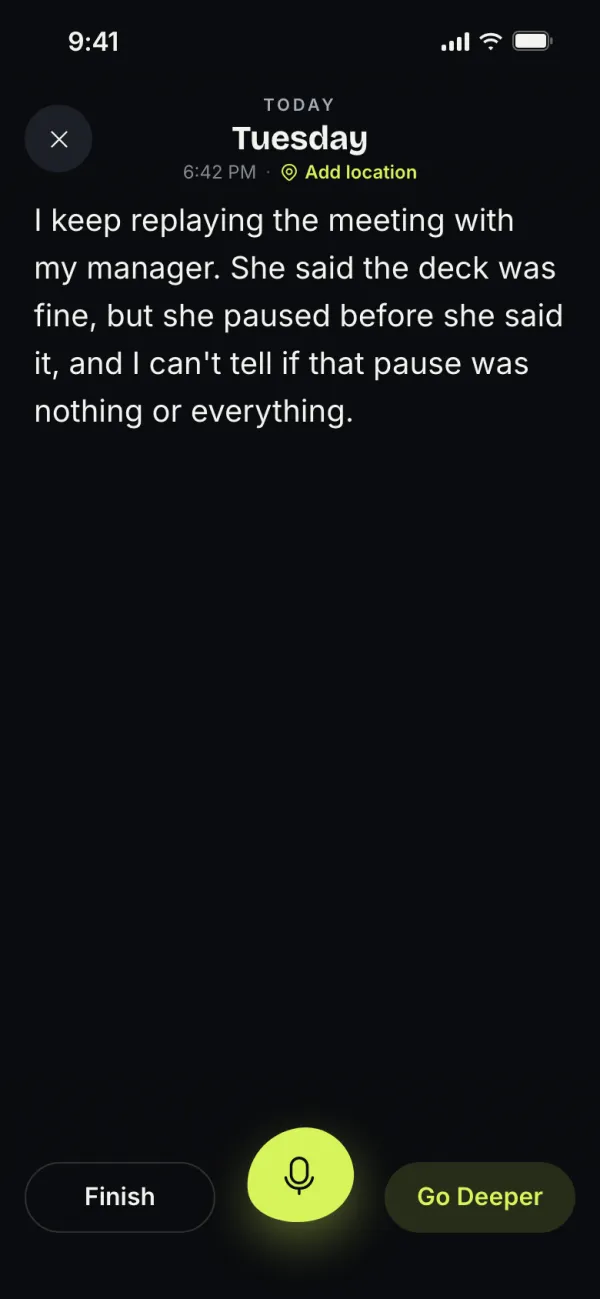
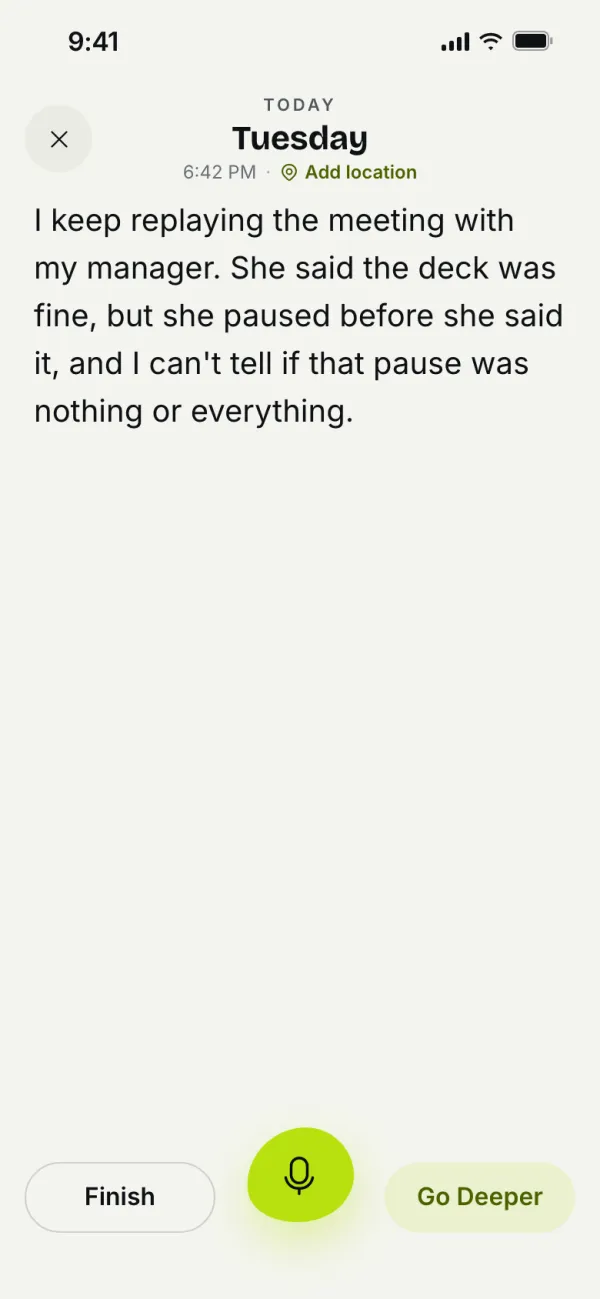 Check inSay it or type it, however it comes out. Messy is fine.
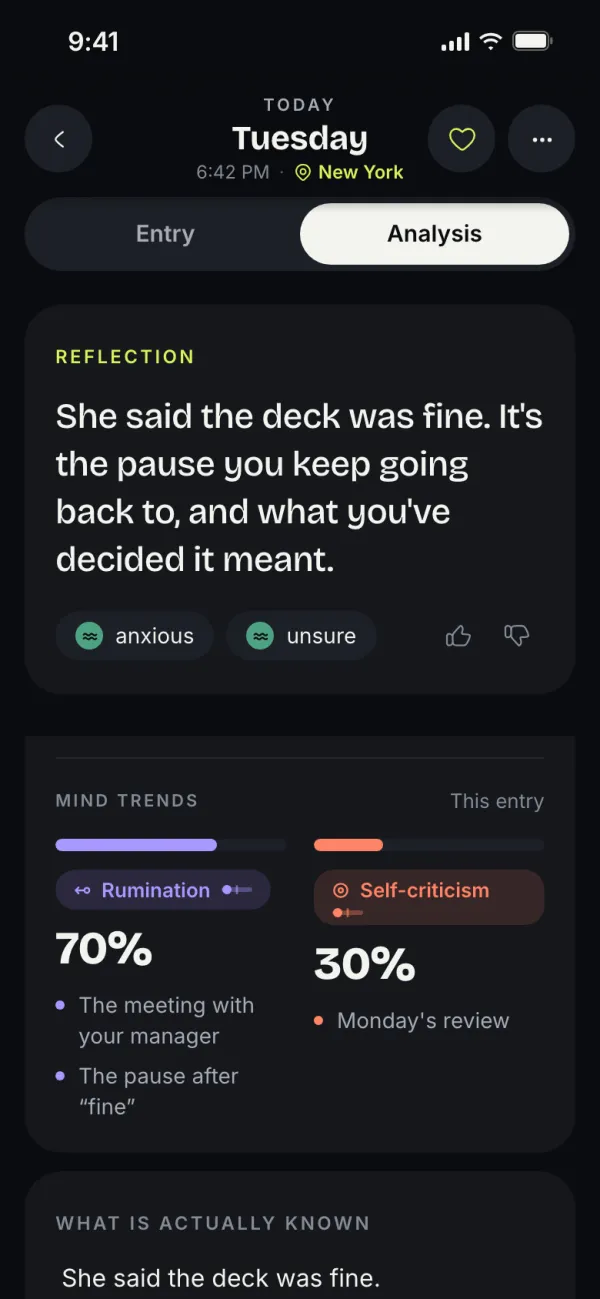
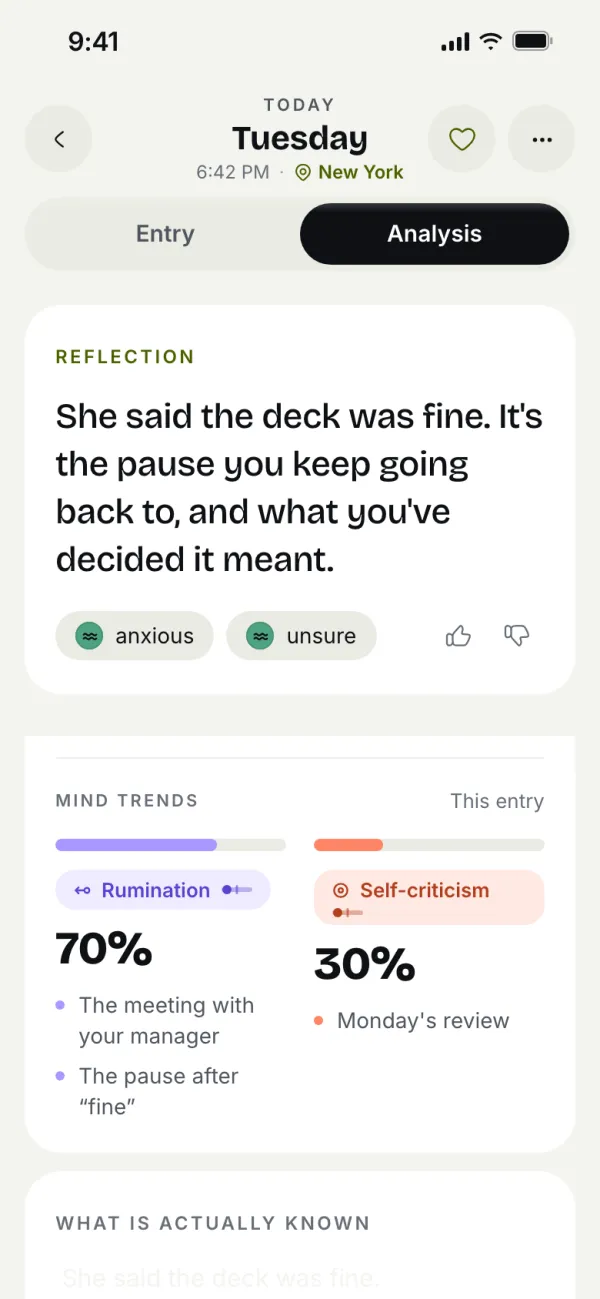 Your Reflectionloopmind reads your check-in and spots what's in it: the pattern showing up, and what your mind added to what happened.
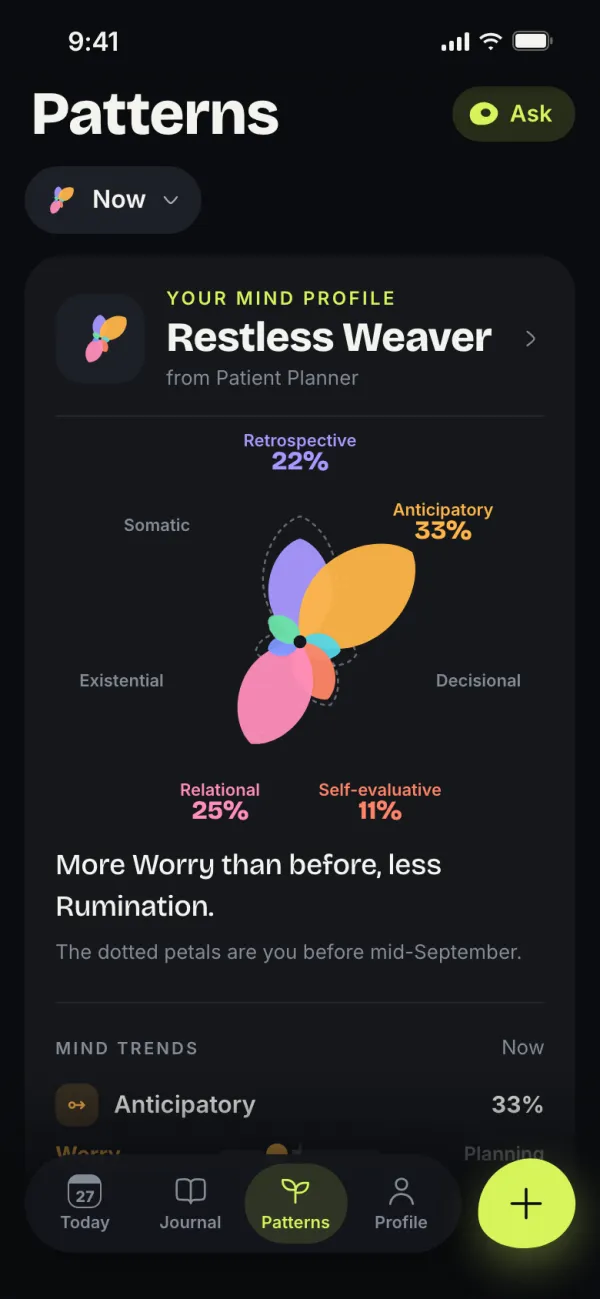
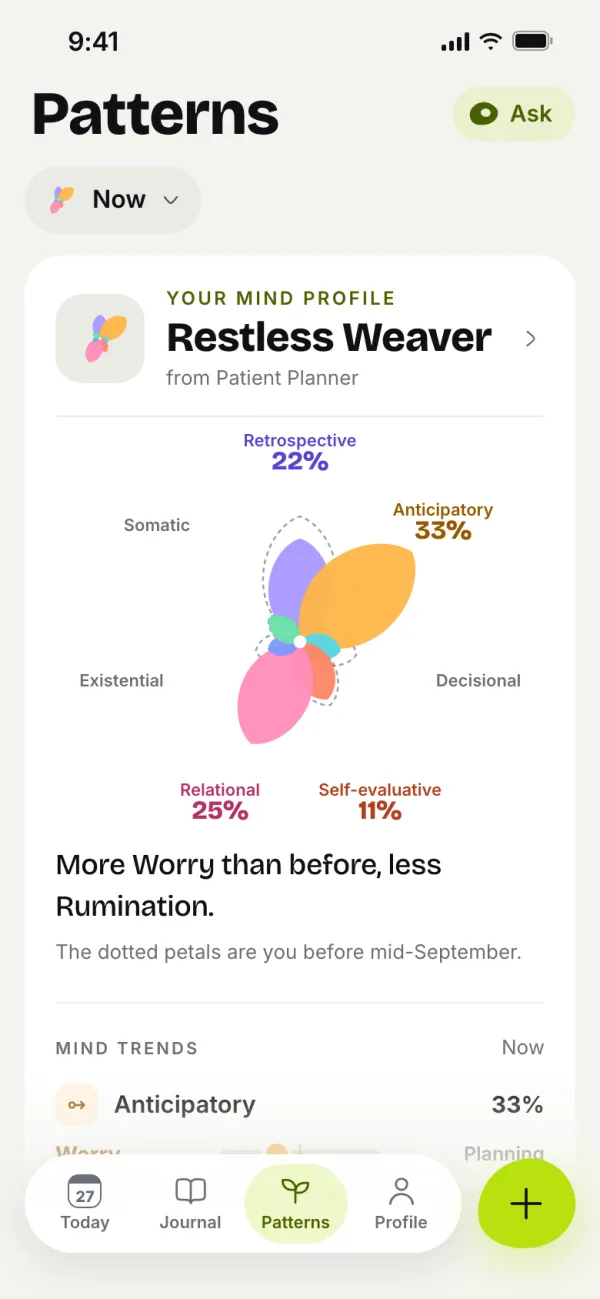 See how you thinkThe more you check in, the more of your mind you can see.
You check in, typed or said out loud, whenever something's on your mind. It can take a minute or ten, and it can be messy. loopmind reads it back with one line about your thinking: what's actually known, set apart from what your mind added, and the patterns that showed up. Here's what that looks like for a made-up check-in.
Presentation to the whole team on Thursday. I've gone through the slides four times and I keep picturing someone asking a question I can't answer. It's 1 a.m. and I'm running it again.
The slides are done; the part you keep rehearsing is a question nobody has asked yet.
A presentation is set for Thursday, and the slides are ready.
A question you can't answer, and the room's reaction to it.
- Anticipatory
- Self-evaluative
Nina's slides are finished. The question nobody has asked yet is the part her mind keeps working on, and seeing those two side by side is what the line is for. It doesn't tell her the presentation will go well, and it doesn't hand her a technique. It shows her where the thinking went.
Over days and weeks, the check-ins add up. You see which patterns come up most, which side of each you've been closer to, and the people, places and feelings that tend to come with them. loopmind Clarity adds the longer view, including how your mind is shifting from month to month, and Ask loopmind, where you ask about yourself and the answers come from your own entries.
What changes when you can see the pattern
Seeing your overthinking over time doesn't come with a promise. What it gives you is information. You might find the Anticipatory pattern runs mostly on Sunday evenings. You might notice that one colleague's short replies turn up in check-in after check-in. You might see that a loop you thought never stopped actually comes and goes: quiet for weeks, then back with the next deadline.
That kind of detail is hard to reach by thinking about yourself in general. It comes from your own words, gathered on ordinary days. It's also why loopmind leaves out diagnosis and advice: it's a mirror, not a therapist. If you're working with one, a record like this can be something to bring to a session. It's a help between sessions, never a replacement. If you need someone to talk to now, the support page lists real helplines.
If you're comparing tools, this look at apps for overthinking sets the options side by side, and the research behind loopmind lists the studies the patterns draw on.
Questions
Why do I overthink everything?
Usually because the questions your mind picks up can't be settled by thinking alone: what someone meant, what might happen, which choice is right. An open question feels like unfinished business, so the mind keeps returning to it. Some people do this around nearly everything, others around one person or one kind of situation.
Is overthinking a mental illness?
No. Overthinking is a habit of thinking, not a diagnosis, and everyone does it sometimes. If it comes with distress that gets in the way of your days, that's worth talking about with a professional. loopmind is a mirror for how you think, not a substitute for care.
Can you stop overthinking completely?
Probably not, and trying to force it tends to backfire: in a well-known study, people asked not to think of a white bear thought of it more afterward. Thinking doesn't switch off on command. What can change is how well you know your own loops: what sets them off, where they go, and when they come back.
Why are racing thoughts worse at night?
At night there's less competing for your attention, so whatever is unresolved gets the whole stage. Tiredness also makes thoughts harder to steer: research on ironic processes found that trying to control a thought under stress or fatigue can bring on the very thought you're avoiding. And at night there's nothing to check a worry against.
Is overthinking the same as rumination?
Rumination is one kind of overthinking: going back over what happened, or over how you feel and why. Overthinking also covers running ahead to what might happen and circling a decision. In loopmind, these are different patterns, each with two sides.
What's the difference between overthinking and worrying?
Worry is overthinking pointed at the future: a chain of what-ifs about what might go wrong. It's one side of what loopmind calls the Anticipatory pattern. The other side is planning, which looks ahead too but turns what might happen into something to prepare for.
- Watkins, 2008. doi.org/10.1037/0033-2909.134.2.163
- Nolen-Hoeksema, 1991. doi.org/10.1037/0021-843X.100.4.569
- Wegner, Schneider, Carter and White, 1987. doi.org/10.1037/0022-3514.53.1.5
- Wegner, 1994. doi.org/10.1037/0033-295X.101.1.34
- Scullin, Krueger, Ballard, Pruett and Bliwise, 2018. doi.org/10.1037/xge0000374
- LaFreniere and Newman, 2020. doi.org/10.1016/j.beth.2019.07.003
Get it out.
See how you think.