Journal prompts for when your thoughts keep going round
Journal prompts are questions you answer on a page to put a thought into words. When your thoughts go round, the ones that tend to move are concrete: what happened, what you actually know, what comes next. Abstract questions like "why me?" tend to circle. Below are prompts grouped by where your thoughts go, plus self reflection questions.

Most lists of journal prompts are written for a quiet Sunday afternoon. What are you grateful for? What made you smile this week? They're harder to use at 1 a.m., when a conversation from Tuesday is on its tenth replay. A gratitude question asks you to look somewhere else, and the replay is still running when you put the pen down.
This guide gives journal prompts for a mind that goes round: concrete questions about what happened, what you actually know, and what comes next. They're grouped by where your thoughts tend to go, and followed by self reflection questions for looking back over a longer stretch. They're questions, not fixes. Each one asks you to put something into words so you can look at it.
Why some journal prompts move and others go round
Thinking about the same thing again and again isn't one habit. A review of research on repetitive thought found it can help or harm, and that a lot depends on how it's pitched (Watkins, 2008). Abstract questions, like "why does this always happen to me?", tend to circle. Concrete ones, like "what happened, exactly?" and "what's the next step?", tend to move.
Abstract questions feel deep, which is part of their pull. But they rarely have an answer you could check, so each pass ends where it started. A concrete question has a smaller answer, and that answer is something you can look at.
An older line of research points the same way. Response styles theory found that dwelling on how you feel, and why you feel it, tends to keep low mood going longer (Nolen-Hoeksema, 1991). Many prompt lists ask exactly that: "why do you feel this way?" On a night when your thoughts are already going round, that question can feed the loop it means to look at.
An abstract prompt, or a concrete one?
- Abstract: Why does this always happen to me?
- Concrete: What happened, in the order it happened?
- Abstract: What does this say about me?
- Concrete: What did they actually say?
- Abstract: Why do I feel like this?
- Concrete: What's the next step, if there is one?
- Abstract: Ends in another why
- Concrete: Ends in a fact or a step
The prompts below lean concrete. Most start from a fact, a time, a sentence or a next step. None of them asks you to feel differently, and none of them has a right answer.
Journal prompts for rumination
Rumination is going back over something that already happened: a conversation, a mistake, a moment you'd play differently now. These prompts follow the concrete moves in order, from what happened to what's next. Pick one group, or one question. A single question answered honestly is enough for a page.
What happened
- What happened, in the order it happened, as a camera would have recorded it?
- Where were you, who was there, and what time was it?
- What was actually said? Write the words, not what you think they meant.
- When did you first start going back over it, and what were you doing then?
What your mind added
- Which sentence keeps coming back? Write it down word for word.
- Which parts of that sentence did you see or hear, and which parts did you fill in?
- Is there an "always" or a "never" in it? Where did that word come from?
- How would someone who was there, and isn't you, describe what happened?
What you know now
- What do you know now that you didn't know then?
- What did you want to happen in that moment?
- Is anything about this still open, or is it over?
What's next
- Is there one thing you could do about this? What is it, and when?
- If there's nothing to do, what is the question you keep asking?
- What would you need to know to close that question? Is it something you can find out?
If the answer to the last one is "nothing I can find out", that's worth noticing too. It often means the question has turned abstract again.
More journal prompts, by where your thoughts go
Going back over the past is one direction. Thoughts also go round a future that hasn't happened, a choice that won't close, a verdict about yourself, or another person's mind. The same concrete moves work on each.
When you keep going over what might happen
- What exactly are you afraid will happen? Put it in one sentence.
- What do you know about it today, and what are you guessing?
- If it did happen, what would you do first?
- What part of this is yours to do before then?
When you can't make up your mind
- What are the options, in one line each?
- What has changed since the last time you went over this?
- What are you waiting to find out, and will more thinking tell you?
If the same choice keeps coming back, the guide to indecision looks at how what-if thoughts keep both sides level.
When the voice is about you
- What exactly did you do, and what did you call yourself for it?
- Which single moment is that verdict built on?
- Whose words are these? When did you first hear them?
When it's about someone else
- What did they actually say or do? Copy the message, if there was one.
- What are you guessing about what they meant?
- If you could ask them one question, what would it be?
Self reflection questions
Self reflection questions work at a different distance. Prompts for rumination look closely at one moment; these look back over a week or a month, from a little further out. Research on self-knowledge suggests people often don't know why they feel or act as they do, and that looking at their own behavior more as an outsider would is one way past that limit (Wilson and Dunn, 2004).
- What came up in your thoughts more than once this week?
- When do your thoughts tend to go round: what time of day, where, after what?
- Which person or topic shows up most in what you think about?
- What did you go over a month ago that you no longer think about? What changed?
- When did going back over something lead somewhere? What was different that time?
- What do you keep coming back to that you haven't said out loud to anyone?
- What do you care about that your loops keep circling?
These are easier to answer with something to look back at. A page from last Tuesday is better evidence than your memory of last Tuesday. The guide to getting to know yourself goes further into that outside view.
Rumination or reflection: two sides of going back
Going back over the past isn't a problem in itself. In a study of 1,328 adults, what had been measured as one habit of rumination came apart into two: brooding, which was linked to lower mood a year later, and reflection, a more problem-solving way of turning inward (Treynor, Gonzalez and Nolen-Hoeksema, 2003).
In loopmind, going back over what already happened is the Retrospective pattern, and its two sides are rumination and reflection. The same memory can sit on either side, depending on the questions you bring to it. That's the idea behind the prompts above. They don't ask you to stop going back. They ask what you find when you do.
What journal prompts can and can't do
Putting a thought into words has been studied for decades. A review of 146 studies of expressive writing found a small effect (Frattaroli, 2006). Single studies point the same way. Students who wrote about a bad experience had fewer intrusive thoughts about it than students who wrote about other things (Klein and Boals, 2001). People who put a word to a feeling were less upset than they expected to be (Lieberman and colleagues, 2011), though not every study agrees. Small is still the honest word. A page doesn't settle a loop, and a list of prompts isn't a method. What a page does is put the thought somewhere you can look at it.
Some prompts ask for the opposite: to let a thought go, or to push it out and think of something else. In the "white bear" study, people asked not to think of a white bear thought of it more afterward (Wegner, Schneider, Carter and White, 1987). A prompt built on pushing a thought away runs into the same problem. The prompts here go toward the thought, not away from it.
A page also has a limit of its own: it shows one night. Whether the same sentence came back on four other nights isn't on it, unless you go looking through old notebooks. If you'd like more structure for a single moment, a thought record, from CBT, is a worked-out version of the same first step.
Seeing your patterns with loopmind
In loopmind, you don't need a prompt to start. You check in, typed or out loud, whenever something's on your mind, in whatever order it comes out. You get one line back about your thinking, with what happened set apart from what your mind added, and the patterns that showed up.
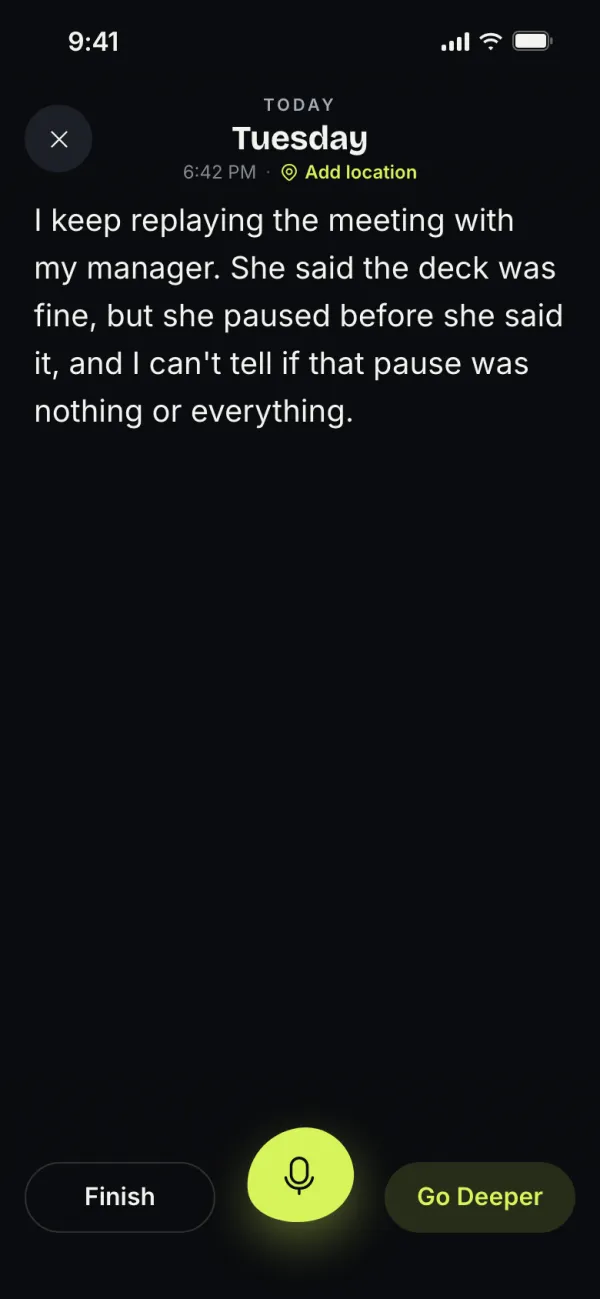
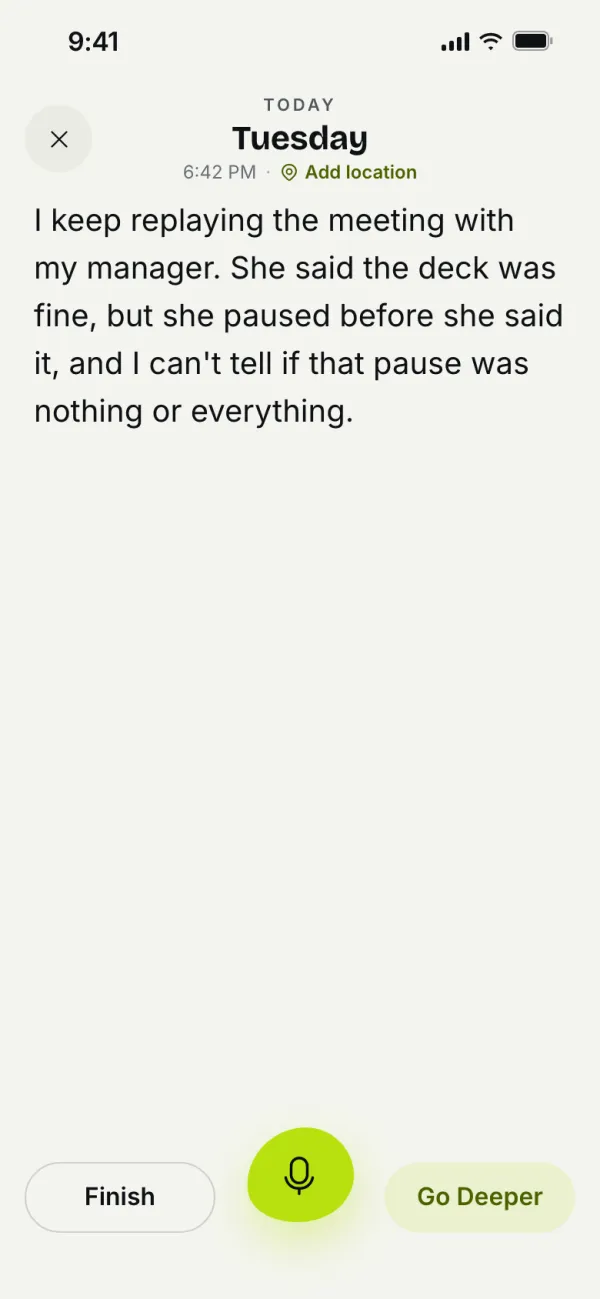 Check inSay it or type it, however it comes out. Messy is fine.
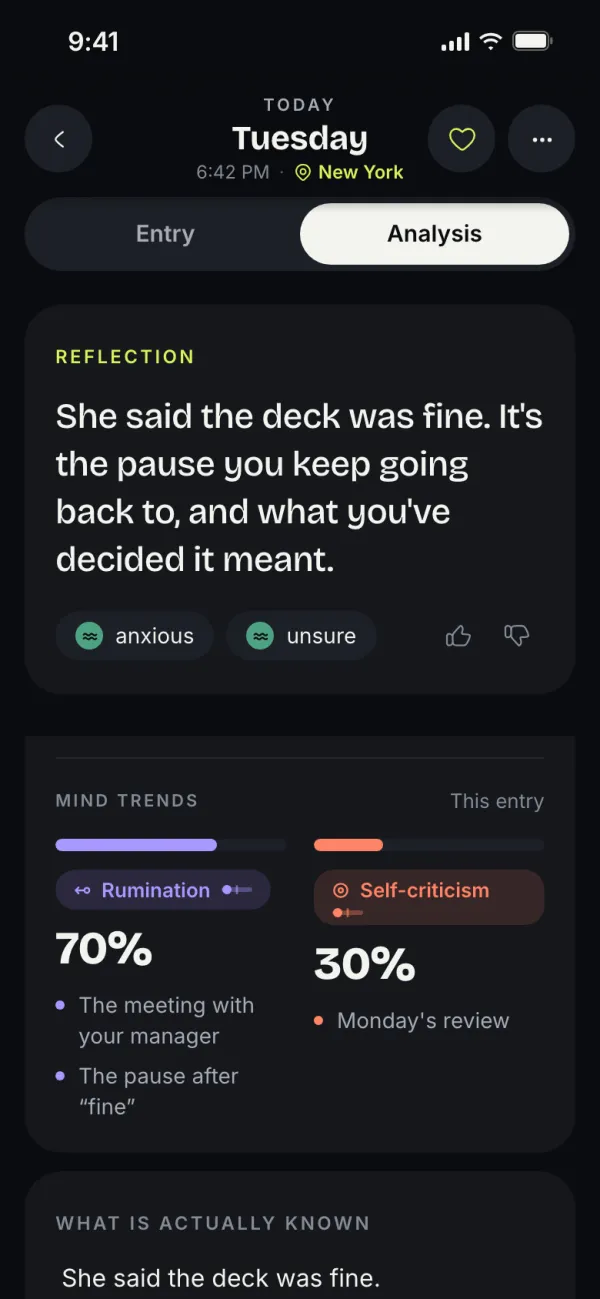
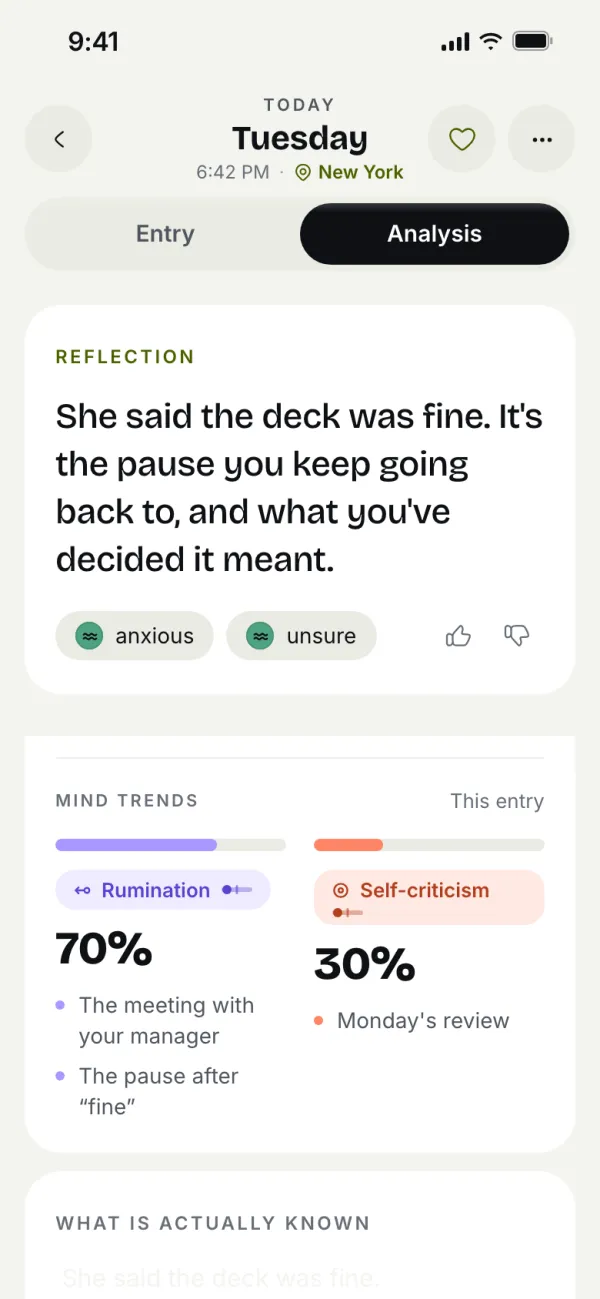 Your Reflectionloopmind reads your check-in and spots what's in it: the pattern showing up, and what your mind added to what happened.
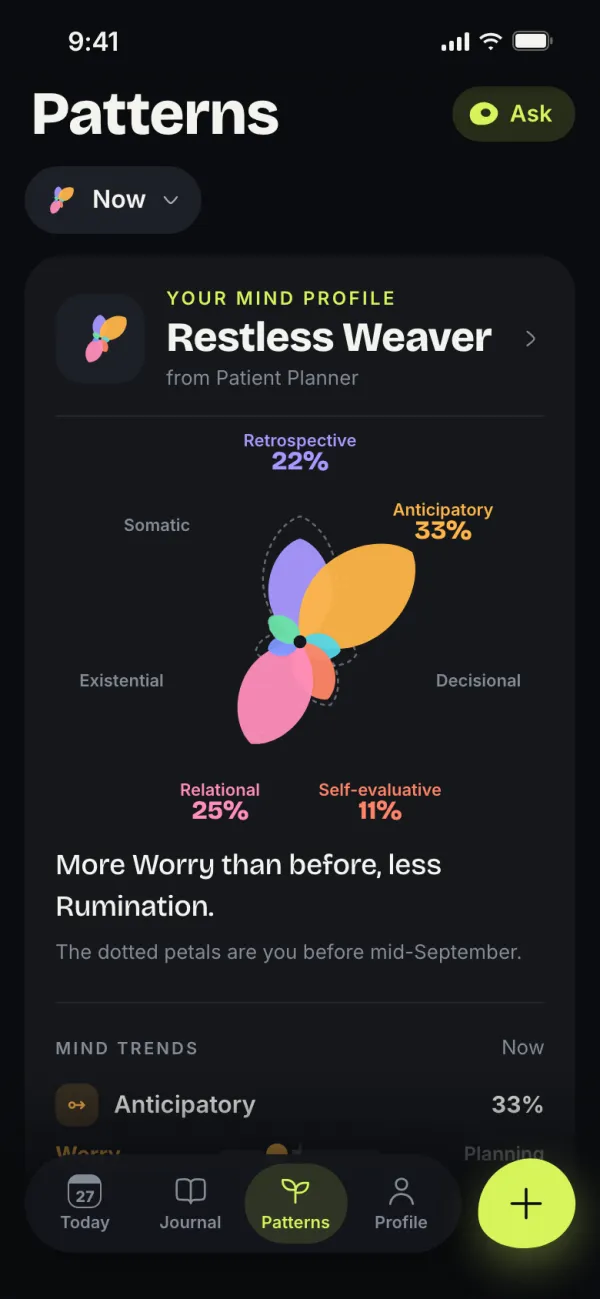
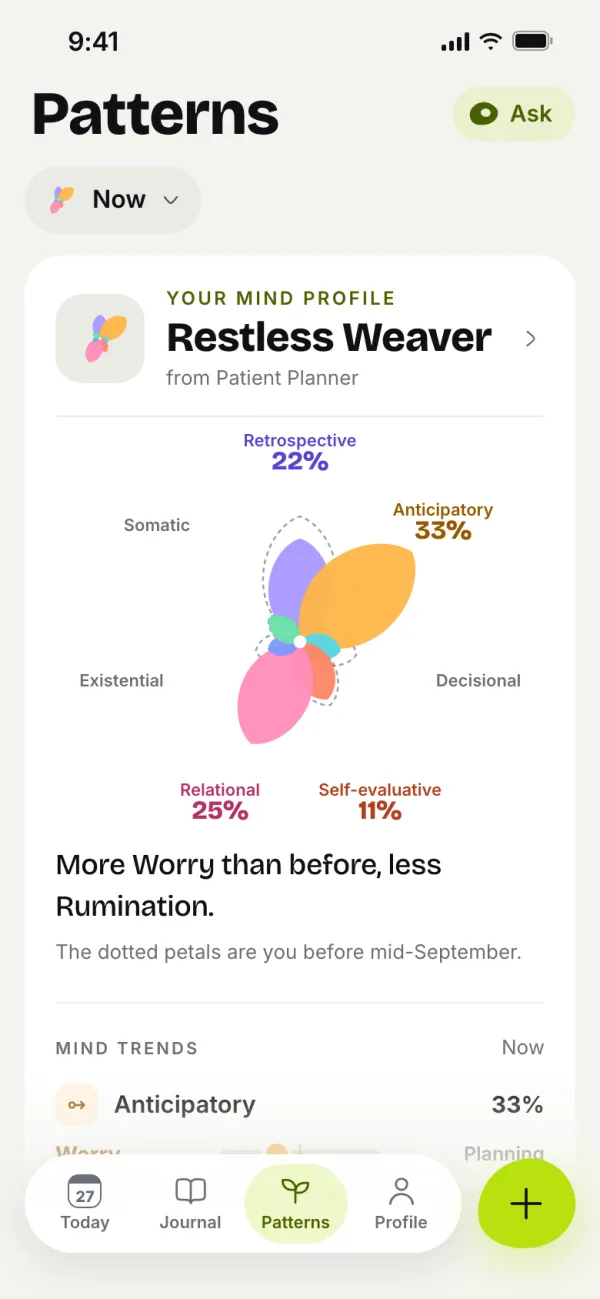 See how you thinkThe more you check in, the more of your mind you can see.
Here's a made-up check-in.
Keep replaying dinner with Julie on Saturday. I made a joke about her new job and she went quiet for a second. Why do I always say the wrong thing?
The dinner gave you one quiet second; the "always" came later, from you.
You made a joke about Julie's new job, and she was quiet for a moment.
That she minded, and that you always say the wrong thing.
- Retrospective
- Self-evaluative
The split in the middle does what the "what happened" and "what your mind added" prompts do, from outside. Claire doesn't get a verdict on whether the joke landed. She gets the one quiet second the dinner actually gave her, set apart from the word she brought home.
Each entry is tagged with the patterns in it. Over weeks, you see how often the Retrospective pattern comes up, which side of it you've been closer to, and what tends to come with it: the same person, the same kind of evening, the same sentence. The research behind loopmind lists the studies this guide draws on.
loopmind Clarity adds daily prompts built from your own patterns and threads, with a new theme every week, and shows how your mind is shifting over time.
When going round is more than a habit
These prompts are for the everyday kind of going round: a conversation on replay, a night spent on one question. If your thoughts come with distress that gets in the way of your days, that's worth talking about with a professional. The guide to overthinking looks at the wider pattern.
loopmind is a mirror, not a therapist, and it isn't a substitute for care. If you work with a therapist, it can be a help between sessions. If an entry sounds like you might be in danger, it says so plainly and shows you real helplines. If you need someone now, the support page lists them.
Questions about journal prompts
What are good journal prompts for overthinking?
Concrete ones. Questions about what happened, what was actually said, what you know for sure and what the next step is tend to move. Questions about why, or what it all says about you, tend to circle. Research on repetitive thinking found the same split: concrete thinking moves, abstract thinking goes round.
What should I write about when my thoughts keep going round?
Start with the facts a camera would have caught: where you were, who was there, what was said. Then write down the one sentence that keeps coming back, word for word. Seeing what happened next to what your mind added is often the clearest page you can get.
Can journaling make rumination worse?
It can. A page that keeps asking why you feel the way you do can become one more round of the same loop. Research on response styles found that dwelling on how you feel and why tends to keep low mood going longer. Prompts that stay concrete are less likely to turn into that.
What is the difference between rumination and reflection?
Both are ways of going back over the past. In a study of 1,328 adults, brooding was linked to lower mood a year later, while reflection was a more problem-solving way of turning inward. The same memory can be met either way, depending on the questions you bring to it.
What are some good self reflection questions?
Questions that look back over a stretch of time rather than one moment: what came up more than once this week, when your thoughts tend to go round, which person or topic shows up most, and what you went over a month ago that you no longer think about.
Does loopmind give journal prompts?
You don't need a prompt to check in in loopmind: you type or say what's on your mind, in whatever order it comes. loopmind Clarity adds daily prompts built from your own patterns and threads, with a new theme every week.
- Watkins, 2008. doi.org/10.1037/0033-2909.134.2.163
- Nolen-Hoeksema, 1991. doi.org/10.1037/0021-843X.100.4.569
- Treynor, Gonzalez and Nolen-Hoeksema, 2003. doi.org/10.1023/A:1023910315561
- Wilson and Dunn, 2004. doi.org/10.1146/annurev.psych.55.090902.141954
- Frattaroli, 2006. doi.org/10.1037/0033-2909.132.6.823
- Wegner, Schneider, Carter and White, 1987. doi.org/10.1037/0022-3514.53.1.5
- Klein and Boals, 2001. doi.org/10.1037/0096-3445.130.3.520
- Lieberman, Inagaki, Tabibnia and Crockett, 2011. doi.org/10.1037/a0023503
Get it out.
See how you think.