Rumination: why your mind keeps replaying the past
Rumination is going back over something that already happened, again and again, without the thinking moving forward. Along the way the question shifts from "what happened?" to "why am I like this?" It isn't a flaw or a diagnosis. It's one side of a thinking pattern whose other side is reflection.

A comment you let pass in a meeting. A message that's gone unanswered since Tuesday. A joke at dinner that fell flat. Hours later, sometimes days later, the scene plays again. Same start, same ending, and the same feeling that something in it is still unfinished.
That's rumination: going back over what already happened, again and again, without the thinking moving forward. This guide looks at how rumination works, why it resists being pushed away, how it differs from reflection, and how it differs from intrusive thoughts, which can feel similar from the inside and aren't.
What is rumination?
The word comes from cows and sheep, which bring their food back up to chew it a second time. The picture fits. The scene is over, it was lived once, and the mind brings it back to work on it again.
In daily life, rumination rarely sounds like a clear thought. It's more like background noise that returns as soon as your attention loosens: on the bus, in the shower, as you're falling asleep. You rephrase what you could have said. You picture the other person's face. You try to guess what they thought. And when you look up, twenty minutes have gone into a conversation that lasted thirty seconds.
Rumination almost always starts on something small and concrete. Then it changes on the way. At first, the question is about the scene: what exactly did I say? After a few rounds, it's about you: why do I always do this, what's wrong with me? The first question has an answer, and often you already know it. The second doesn't, at least not one you can find by replaying the scene. So the mind replays it again, looking in the details for an answer that isn't there.
Ruminating thoughts: what they sound like
Ruminating thoughts have a recognizable shape. A few that come up often:
- Why did I say that?
- What did she mean by it?
- What if I'd left earlier?
- Why does this always happen to me?
- What's wrong with me?
Notice how the list moves. It starts with questions about the moment and ends with questions about the person asking. That drift is what keeps the loop going. Research on repetitive thinking suggests the same habit tends to move when it stays concrete ("what happened, and what's next?") and to circle when it turns abstract ("why me?") (Watkins, 2008). Ruminating thoughts usually live at the abstract end.
Feelings get pulled in too. Response styles theory, proposed by the psychologist Susan Nolen-Hoeksema, held that dwelling on how you feel and why tends to keep a low mood going longer (Nolen-Hoeksema, 1991). Going over a feeling again and again isn't always the same as working through it.
Rumination or reflection?
Going back over the past isn't a problem in itself. It's how people learn: you think back on a conversation that went badly, see where it went wrong, and handle the next one differently. The trouble isn't looking back. It's looking back while nothing moves.
A study of 1,328 adults split rumination into two parts. One, brooding, was linked to lower mood a year later. The other, reflection, was a more problem-solving way of turning inward (Treynor, Gonzalez and Nolen-Hoeksema, 2003). The same move, going back, could head in two directions.
Reflecting, or ruminating?
- Reflecting: Starts from one moment and looks for what it shows
- Ruminating: Replays the same scene and finds nothing new
- Reflecting: Asks what happened, and what comes next
- Ruminating: Asks why: why me, why always
- Reflecting: Stops when nothing new is coming
- Ruminating: Keeps going because the answer doesn't come
From the inside, the two can feel alike. One sign: at the end of a round, do you know something you didn't know at the start? If the answer is no, several rounds in a row, the thinking has probably stopped reflecting and started ruminating.
In loopmind, going back over what happened is the Retrospective pattern, one of seven pattern families. Like every pattern, it has two sides, and they follow exactly this split: rumination and reflection.
Seeing rumination as one side of a pattern changes the question you ask about it. Rumination isn't a defect. It's a useful ability running without traction: the same one that lets you understand an argument or learn from a mistake. And a single memory can move from one side to the other. The meeting you went over and over on Monday can look different the week after. The event doesn't decide the side; the way the thinking returns to it does.
Rumination vs intrusive thoughts
Rumination often gets mixed up with intrusive thoughts, because both involve thoughts you didn't ask for and can't easily put down. They're different experiences, and telling them apart is a first step toward describing what's going on.
Rumination is something you keep going back to. It feels like your own thinking, even when it's unpleasant. It's usually tied to something that happened, and to something you care about: you go over the meeting because the work matters to you, or the argument because the person does. You could say what you're doing with it ("I'm trying to work out what she meant"), even if it isn't getting anywhere.
An intrusive thought arrives. It's a sudden flash, an image, an urge or a few words, that comes out of nowhere, sometimes in the middle of something ordinary like cooking or crossing a street. It often feels foreign, out of character, the opposite of what you'd want. What usually follows isn't a long chain of reasoning but a jolt of alarm: why did I just think that?
Rumination, or an intrusive thought?
- Rumination: A thought you keep going back to
- Intrusive thought: A thought that arrives out of nowhere
- Rumination: Feels like your own, about something you care about
- Intrusive thought: Feels foreign, often the opposite of what you want
- Rumination: Usually tied to something that happened
- Intrusive thought: Often set off by nothing, or by an ordinary moment
- Rumination: Runs for minutes or hours, often when things go quiet
- Intrusive thought: A flash, then alarm at having had it
The two can meet. An intrusive thought can set off rumination, when the mind starts going over the thought itself and what it might mean. And many people know both. Neither label is a diagnosis, and this guide isn't one either.
If unwanted thoughts come often, cause a lot of distress, or come with urges to check, avoid or repeat things until they feel right, a mental health professional can help work out what's happening. The same goes for rumination that takes up much of your days or nights, or that comes with low mood that doesn't lift. If you need someone to talk to now, the support page lists real helplines.
Why "just stop thinking about it" doesn't work
The most common advice about rumination is to let it go: move on, stop thinking about it. The catch is that a scene that feels unfinished doesn't put itself away on command.
In a classic study, people asked not to think about a white bear thought about it more afterward than people who had been free to think about it all along (Wegner, Schneider, Carter and White, 1987). Later work on what Daniel Wegner called ironic processes found that under stress or tiredness, trying to control a thought can bring on the very thought you're trying to keep out (Wegner, 1994). That's close to the state people ruminate in most: late, worn out, after a long day.
This applies to unwanted thoughts of both kinds. Pushing a thought away keeps it close, because to check that it's gone, the mind has to keep it in view. The guide to overthinking looks at this more closely. Between fighting a thought and being carried by it, there's a third position: looking at it. Seeing the scene come back, noticing the moment the question slides from "what" to "why", recognizing the loop when it comes round again.
Seeing your own rumination
Rumination lives easily in your head, where everything stays blurry: half-sentences, images, a tight feeling somewhere. Once you say it out loud or type it, it takes a shape. It has a beginning, people, a moment. And you can look at it again later.
Putting experience into words is one of the oldest ways of making sense of it, and a review of 146 studies of expressive writing found a small effect (Frattaroli, 2006). In one experiment, students who wrote about a bad experience had fewer intrusive thoughts about it than students who wrote about a positive experience or a trivial topic (Klein and Boals, 2001). And in three studies, people expected that naming a feeling would make them more upset; each time it left them less upset (Lieberman and colleagues, 2011), though not every study agrees. The more useful part here is something else: once a rumination is in words, you can compare it with the ones from the days before. Looked at a few days later, it often shows what was invisible in the moment. The same word coming back, "again", "always". The same person at the center. The same hour of the evening.
That's the idea behind loopmind.
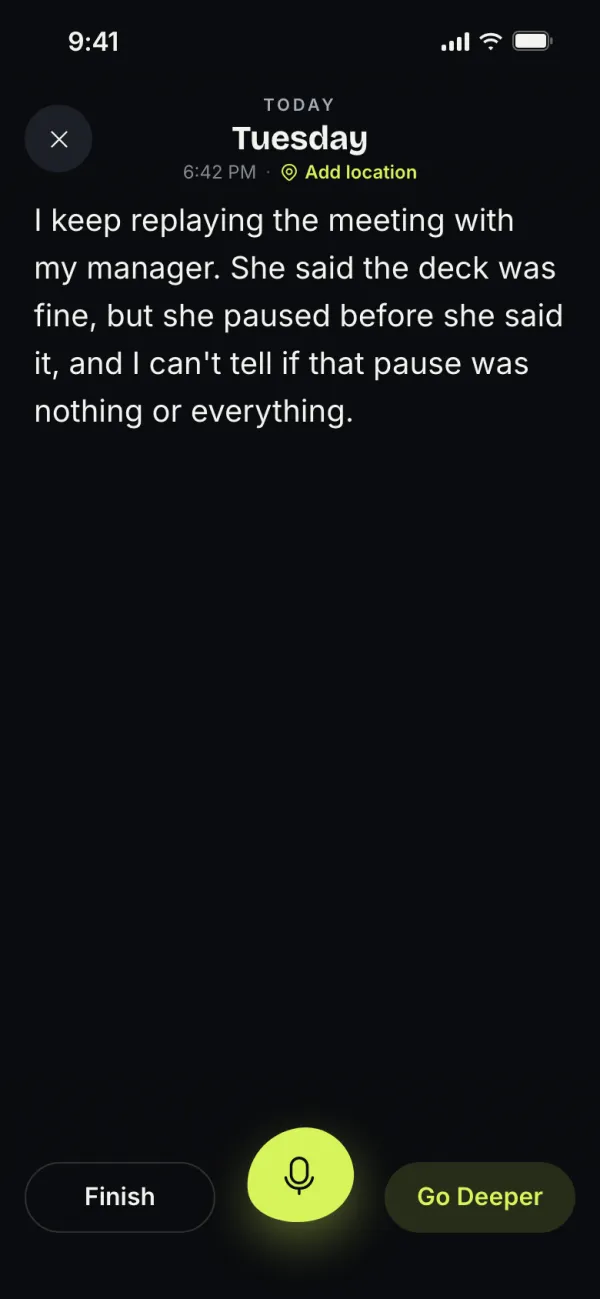
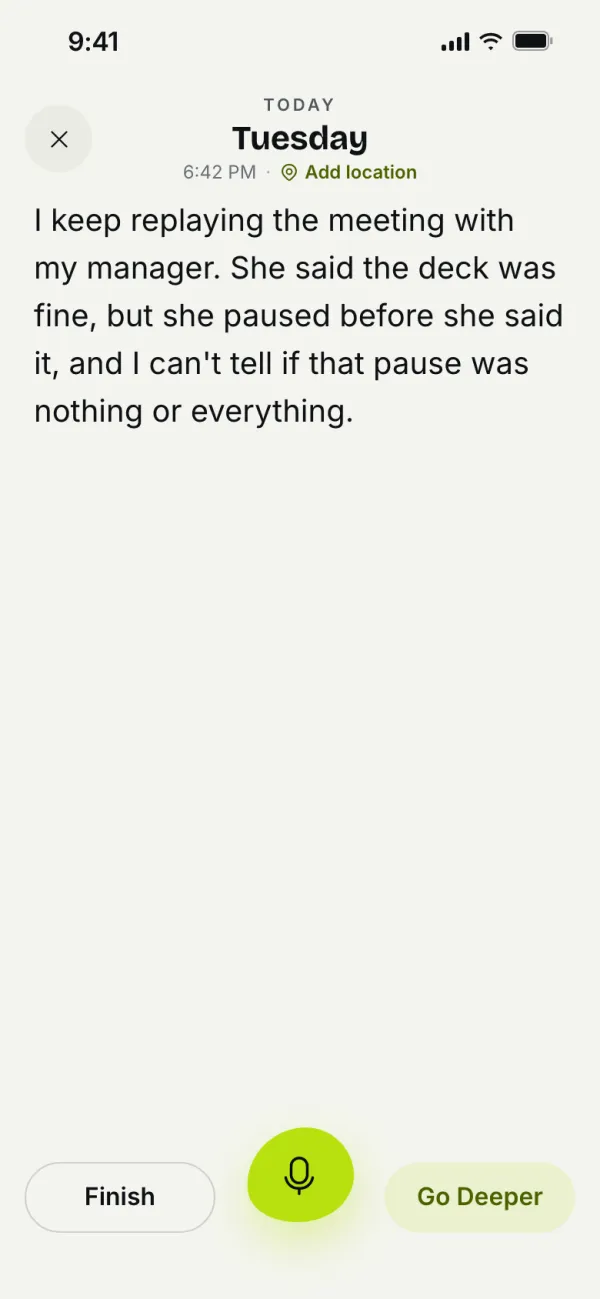 Check inSay it or type it, however it comes out. Messy is fine.
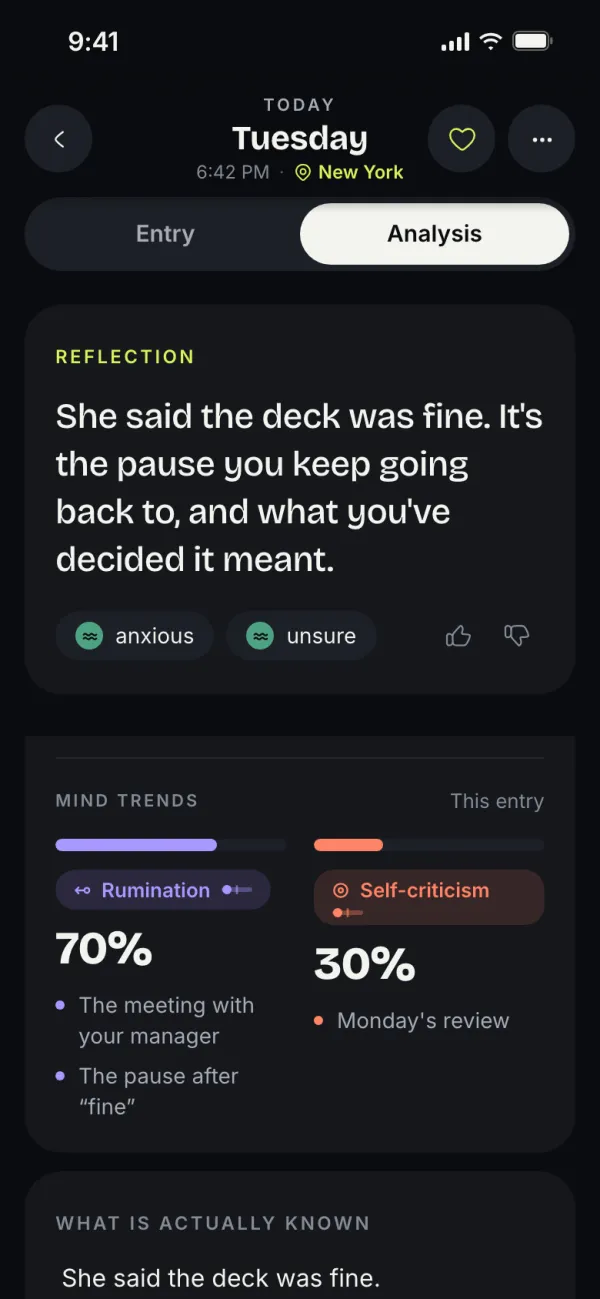
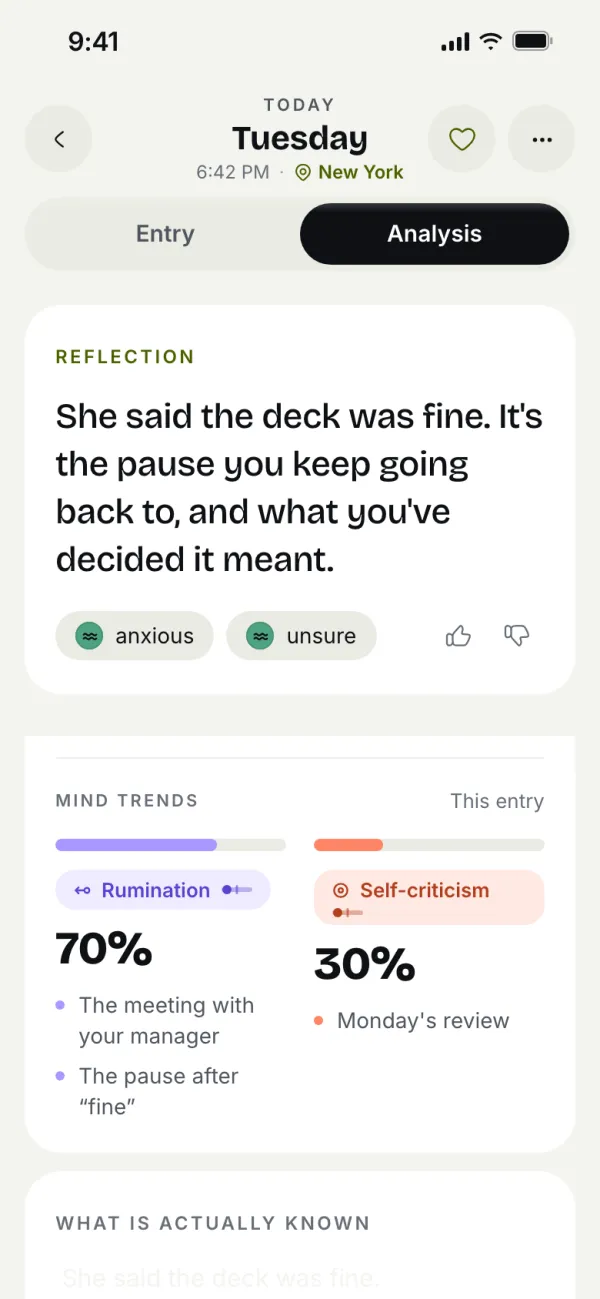 Your Reflectionloopmind reads your check-in and spots what's in it: the pattern showing up, and what your mind added to what happened.
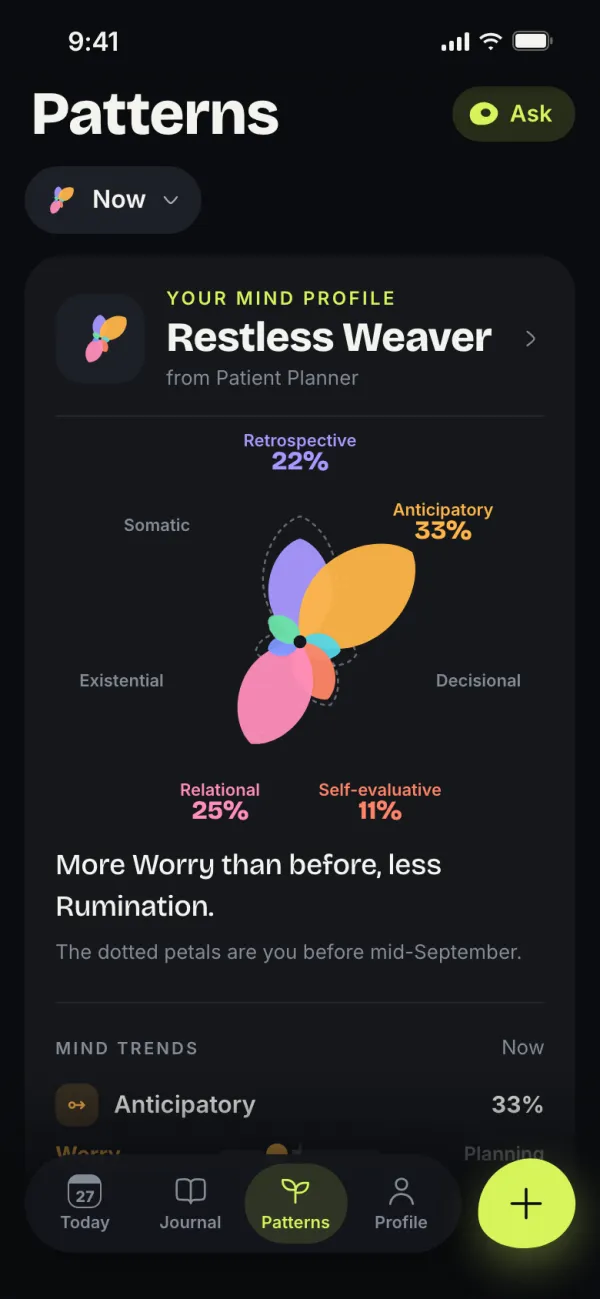
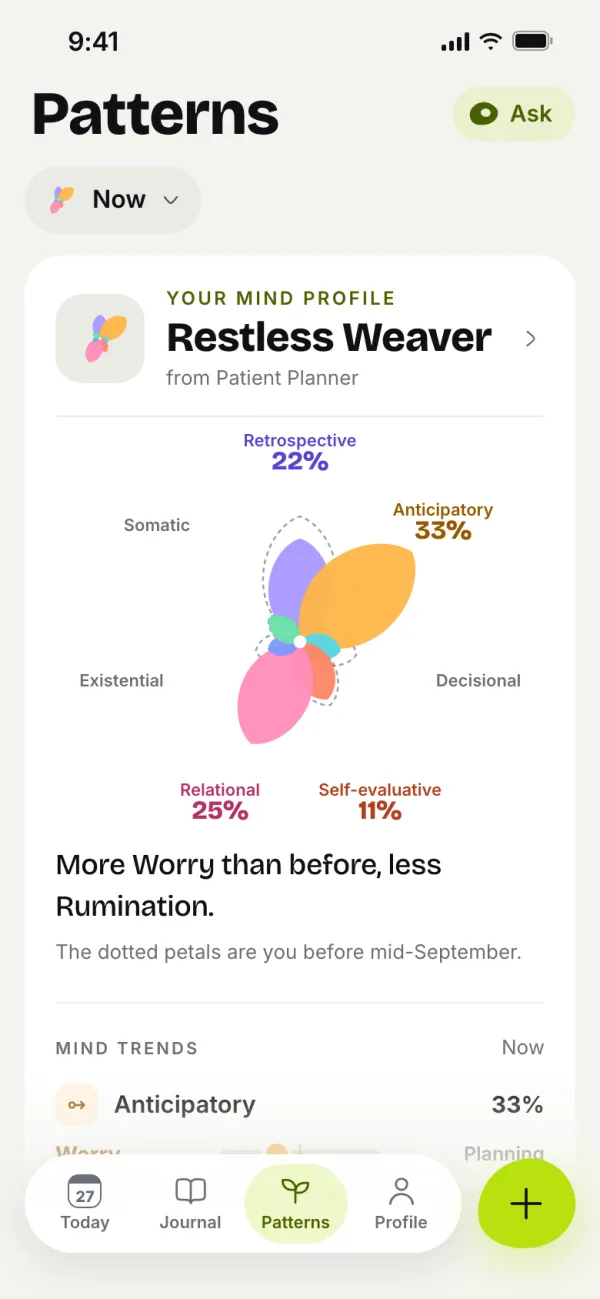 See how you thinkThe more you check in, the more of your mind you can see.
When a scene keeps replaying, you check in, typed or out loud. After each check-in, loopmind gives you one line back about your thinking: what actually happened, set apart from what your mind added, and the patterns that showed up. Here's what that looks like for a made-up check-in.
Three days since the dinner at Tom's and I'm still replaying the joke I made that nobody laughed at. I keep asking myself why I always say the wrong thing in a group.
You've replayed the same ten seconds of the dinner, and the question has moved from what you said to what it says about you.
At a dinner, one joke didn't land, and the conversation moved on.
That everyone noticed, and that it's "always" like this.
- Retrospective
- Self-evaluative
The line doesn't tell Julie the dinner went fine, and it doesn't hand her a way to move on. It points to the moment the question changed. Over days and weeks, your entries add up: you see which patterns come up most, which side of each you've been closer to, and the people and places that tend to come with them. loopmind Clarity adds the longer view, including how your mind is shifting from month to month.
What your ruminations point to
People don't ruminate about just anything. The scenes that come back almost always touch something that matters: a relationship you care about, work you want to do well, the picture you have of yourself. Looked at together over a few weeks, your ruminations draw a fairly precise map of what you care about.
That kind of detail is hard to reach by thinking about yourself in general. It comes from your own words, gathered on ordinary days. It's also why loopmind leaves out diagnosis and advice: it's a mirror for how you think. If you're working with a professional, a record like this can be something to bring along, a help between sessions and never a replacement.
If the scene you keep replaying is a choice you already made, the guide to indecision follows that loop. The thought record guide shows the older worksheet that also sets what happened apart from what the mind added. And the research behind loopmind lists the studies the patterns draw on.
Questions
What is rumination?
Rumination is going back over something that already happened, again and again, without the thinking moving forward. It often starts with a small, concrete moment and drifts toward bigger questions about yourself. Everyone does it sometimes, especially around things that matter to them.
What's the difference between rumination and intrusive thoughts?
Rumination is thinking you keep returning to: it feels like your own, and it's usually about something that happened and that you care about. An intrusive thought arrives suddenly, as a flash, and feels foreign, often the opposite of what you want. One you keep going back to; the other comes to you.
Is rumination a sign of depression?
Not by itself. Everyone ruminates now and then. Research has linked one kind of rumination, brooding, to lower mood later on, so if it takes up a lot of your days or nights, or comes with low mood that doesn't lift, it's worth talking about with a professional. loopmind is a mirror for how you think, not a diagnosis or a substitute for care.
Why do I ruminate at night?
At night there's less competing for your attention, so an unfinished scene from the day gets the whole stage. Tiredness also makes thoughts harder to steer: research on ironic processes found that trying to control a thought under stress or fatigue can bring on the very thought you're avoiding.
Is rumination the same as overthinking?
Rumination is one kind of overthinking: the kind that looks back. Overthinking also covers running ahead to what might happen and circling a choice. In loopmind these are different patterns, and rumination is one side of the Retrospective pattern, with reflection on the other.
- Nolen-Hoeksema, 1991. doi.org/10.1037/0021-843X.100.4.569
- Treynor, Gonzalez and Nolen-Hoeksema, 2003. doi.org/10.1023/A:1023910315561
- Watkins, 2008. doi.org/10.1037/0033-2909.134.2.163
- Wegner, Schneider, Carter and White, 1987. doi.org/10.1037/0022-3514.53.1.5
- Wegner, 1994. doi.org/10.1037/0033-295X.101.1.34
- Frattaroli, 2006. doi.org/10.1037/0033-2909.132.6.823
- Klein and Boals, 2001. doi.org/10.1037/0096-3445.130.3.520
- Lieberman, Inagaki, Tabibnia and Crockett, 2011. doi.org/10.1037/a0023503
Get it out.
See how you think.